
Fix Your Position: Is Your Business Really on Course to Being More Regenerative?

 iHeartRadio iHeartRadio
 Apple Podcasts Apple Podcasts
 Spotify Spotify
 Pandora Pandora
 Youtube Music Youtube Music
 Deezer Deezer
 Spreaker Spreaker
 Podcast Addict Podcast Addict
 Castbox Castbox
 PocketCasts PocketCasts
 Castamatic Castamatic
 Goodpods Goodpods
 Overcast Overcast
 Podurama Podurama
 Podverse Podverse
 YouTube YouTube iHeartRadio iHeartRadio Apple Podcasts Apple Podcasts Spotify Spotify Pandora Pandora Youtube Music Youtube Music Deezer Deezer Spreaker Spreaker Podcast Addict Podcast Addict Castbox Castbox PocketCasts PocketCasts Castamatic Castamatic Goodpods Goodpods Overcast Overcast Podurama Podurama Podverse Podverse YouTube YouTube
Would you sail across an ocean without knowing where you were? Most leaders know their position and their business's position using conventional metrics of success. But what if we are measuring the wrong things?
Today I'm kicking off a three-part series on becoming a regenerative business. We'll use Bill Reed's trajectory—from conventional to green, sustainable, restorative and regenerative. We'll explore different assessments to help you know where your business is along this trajectory.
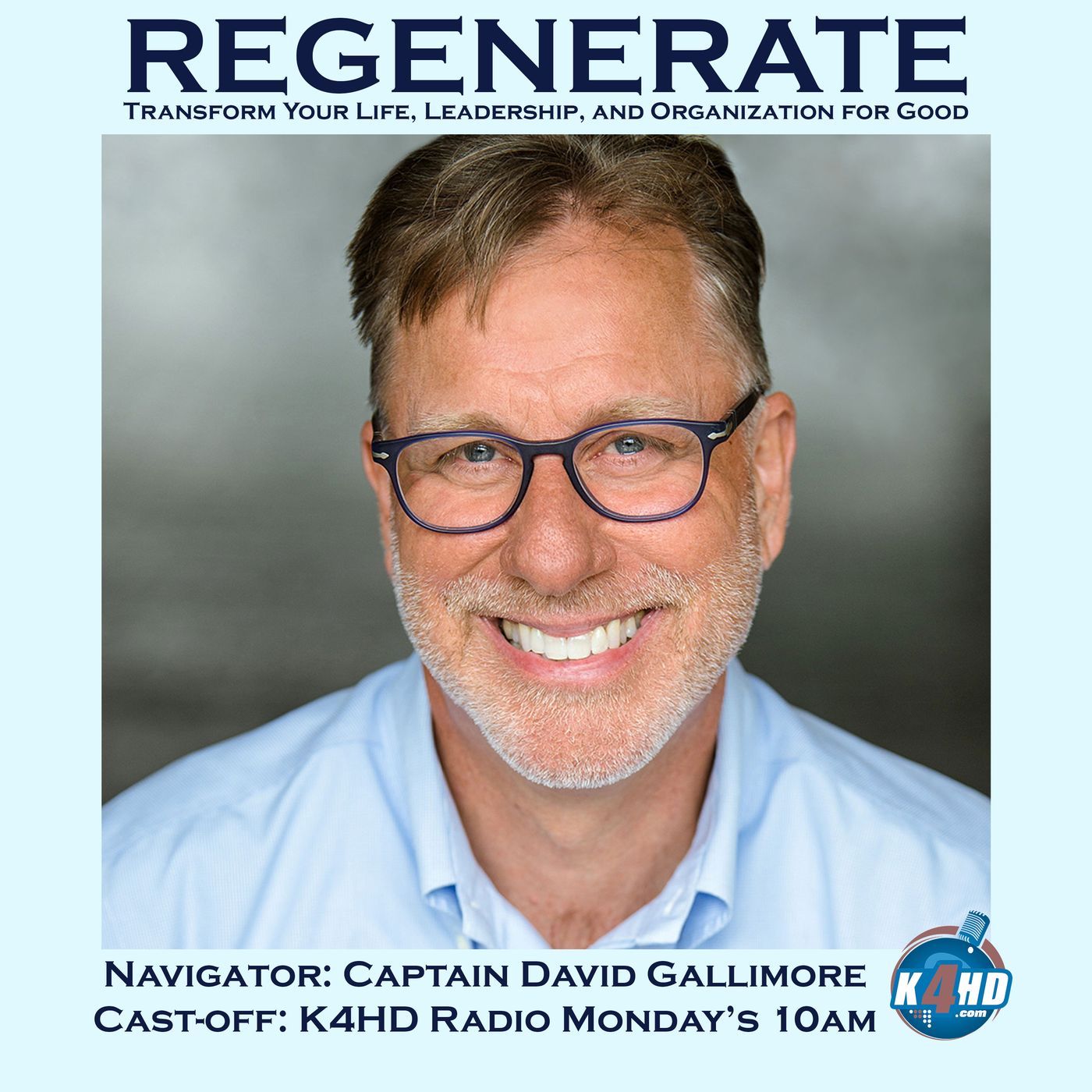
REGENERATE is broadcast live Mondays at 10AM PT on K4HD Radio - Hollywood Talk Radio (www.k4hd.com) part of Talk 4 Radio (www.talk4radio.com) on the Talk 4 Media Network (www.talk4media.com). REGENERATE TV Show is viewed on Talk 4 TV (www.talk4tv.com).
REGENERATE Podcast is also available on Talk 4 Media (www.talk4media.com), Talk 4 Podcasting (www.talk4podcasting.com), iHeartRadio, Amazon Music, Pandora, Spotify, Audible, and over 100 other podcast outlets.
Become a supporter of this podcast: https://www.spreaker.com/podcast/regenerate--6862974/support.
0:04 Ahoy! Captain David Gallimore welcomes you aboard the Regenerate Show, live Mondays, 10 a.m. Pacific on K4HD Radio at K4HD. com. Now, here's your host, Captain Dave, your personal regenerator. All aboard! Ahoy! And welcome aboard Regenerate. I'm Captain Dave, your personal regenerator. So this show is meant to be a safe harbor from all the storms that are raging right now, economic pressures, war, global uncertainty, and of course, AI that's reshaping the ground under our feet. But you're not sailing these storms alone.
0:46 And what I'm trying to create is a safe place for people to talk about the messy middle, the part of the transformation that is personal and professional and organizational. A key principle of the show is regeneration, though my own definition is evolving, especially as I live it and breathe it. But regeneration draws on 3.8 billion years of life's own logic. How can life restore vitality across every living system? So consider a forest. When I walk into a forest, we've just moved from the city into the country.
1:28 And I take a walk with the dogs, with my wife, with my son almost every day and just get renewed of what that forest is creating oxygen for us to breathe. It's the whole life cycle of birth growth and ultimately death that then creates the nutrients for the next generation to thrive. So working together, we're a group of regenerators who are moving beyond just do no harm. or sustainable thinking, to do more good, to renew, to restore, to regenerate. So if you're a longtime crew member or just joining for the first time, welcome aboard. So here's my promise. First, we're going to have some fun. Now, I'm my own guest today, so I guess I get to laugh at my own jokes. But when we're laughing, we're learning. Number two, I hope to leave you inspired. And finally, number three, leave you that one takeaway that you can apply before you go to sleep tonight. So please grab a pen transformations happen here. So our theme today is fix your position.
2:33 Now that's a term that we maritime captains use, where you need to know where you are at any given point along the course that you've charted. And it's not easy to fix your positions. With GPS, it's very easy to fix your position, but in the old school ways with celestial navigation or with what's called dead reckoning, where you take relative bearings, three different relative bearings to create a triangle that is approximately where you are. So this theme is really about where are you? What's your position fix for a business that's on the road to being more regenerative? And part of it is to understand, well, where am I on that road? Where am I on that position? So would you set sail across from an ocean without knowing where you're starting from or where you are along that journey? Most leaders know their position and their business's position using conventional metrics of success. But what if we're measuring the wrong things to know our position?
3:38 So as I mentioned, I'm my own guest kicking off a three-part series on becoming a regenerative business. My belief and the research I think is bearing this out, no one that I know of there yet. I think it's a growth opportunity. It's a journey. You heard me talk about Patagonia two episodes ago and then Interface last week's episode. Sorry, two weeks ago was Interface and three weeks ago was Patagonia because we had Stacey Berger last week. So those prior episodes all speak to businesses that are in process of becoming more regenerative.
4:25 So we're gonna use Bill Reed's trajectory, his eco-design trajectory from conventional to green, sustainable, restorative, and finally regenerative. And to take an honest reading of where your business might be. And I'm also gonna share where mine is too. So I promise you'll leave with a simple way to assess yourself and your business. So let's take some fixes, And before the day is done, see where your next leg of your adventure might be. But what I'd like to do is ask Rebel to please put up the slides. Thank you so much. So this is the first phase of the three-part series, assessment phase. And I don't know if you are as moved as I am by the blue orb, but this was taken by the astronauts. I believe it was Apollo 16.
5:17 And It's reminded us, I think, as human beings, that we are this sole planet that has life. And there's a lot of scientists, a lot of astronomers and physicists that are trying to figure out if there is life elsewhere. But right now, this is our planet, our only home. And as a maritime captain, number one responsibility is to take care of our vessel. So David Pogue wrote a very interesting book. about how to survive climate change. And, you know, regardless of the root cause of climate change and all of these challenges that you're going to see on the screen for just a moment, things are changing.
6:04 Mother Earth is changing. She's in a receding ice age and human beings are changing our environment. We certainly have experienced some of the hottest summers this summer. Some people are experiencing the coldest winters they've ever seen. So it's not just about heat. It could be just about weather extremes, which is leading to fires and to heat, to drought and a number of these other challenges that you see on this slide. One of the fascinating things is, you know, how people are adapting. And one of the things that I didn't realize at the time, but even our our test scores are being impacted. Certainly through generative AI, young people are studying and writing papers and preparing their homework.
6:56 But when it comes to taking tests, they're not able to do as well. But there's actually a climate-related reason why they're not. And it's fascinating to me how we're all interrelated. So I think this is an important distinction, that there are these three aspects, mitigation adaptation, and sorry to be a David Downer, but suffering. And I think it's going to be really challenging as we get further and further into the next decade. Things are definitely accelerating. My friend Tor Olson, who is also in a prior episode, and we'll put these episodes in the show notes for you.
7:41 He talks about how the Southern Hemisphere, specifically Antarctica, are really heating up and things are starting to accelerate even beyond what we thought they might. So things are moving faster than even scientists were forecasting just a few short years ago. So that's going to require us to do more adapting. You look at this from an economic perspective, these are older statistics, global economy, about 2.5 trillion, and this is going to increase you know, over the years. So the greatest effects, of course, this is. Partly what moves my heart. I think about Daisy, our two and a half year old granddaughter, and Calvin, our two month old grandson, and what life do I want to leave for them. But the other part that just, you know, really moves me deeply is the folks least doing the polluting are the ones that are the gravest experiencing the effects of that. And that just doesn't seem fair to me. And then finally, what is our mitigation strategy? Well, this is a bit of an old slide. I realize now I need to update this from sustainability to regeneration.
9:02 I had an epiphany back in summer of 2024 when I realized that sustainability was not going to be sufficient. Do no harm was not going to get the job done because if based on the consensus of the scientific community around the globe, it's pretty clear to everybody that if we stop burning fossil fuels tomorrow, the planet would still overheat because there's so much methane and CO2 and other gases in the world. And then Tor Olson has reminded me that the acceleration of the heating up of the ocean is really changing things quickly. The Antarctica Antarctic ice, for example, that's not just melting, but it's breaking up, it's calving, it's shattering into smaller pieces, which then obviously if you've got a lot more small pieces, that's going to melt faster.
10:00 Than a block of ice. So what we have to do is think a little bit about how do we change our lifestyle a little bit each day, each month, each year to be a little bit more regenerative? How do we help our businesses become more regenerative to balance the needs of the present against the needs of future generations. Not easy. And again, our blue orb, our only home, despite what Elon Musk and others are saying about colonizing Mars and the moon, I can't see anytime soon 8 billion plus people moving off planet. So how do we move from what some would say looks a picture like this on the left-hand side to a picture transitioning back to the way things were decades ago, healthy air, healthy water, healthy salmon in the Pacific Northwest is a leading indicator of safe and healthy ecosystems.
11:02 How do we do that? Well, I formed probably about five years ago now, this just very simple stair step. And the idea was it has to begin with each of us. And so as many of you have been hearing on the Regenerate show, I've been on this mission from God to help myself be a better person, rewire my identity. We've sold our large home and large property that was a lot of water to water the lawn and a lot. Of heat to heat the pool. We shed all of that, gave it. To a family that will be much better served by that home and that property. We're down to one vehicle.
11:48 And we're trying to do our part eating locally, eating organic, whatever we can do. And so as you move your way up the. Stairs, my belief, like ripples in a pond, when you throw a pebble, it's going to create positive ripples, hopefully. And so now we're getting close to this rung about the business level. And so that's where the focus is today. But hopefully this stair step might inspire you in your own journey. to become part of the solution, to become a bit more regenerative day by day, week by week, month by month. It's a journey. It's not like turning on a light switch where we're going to go from kind of conventional ways of being, extractive ways of being, to sustainable and then upward to restorative and regenerative. So I wanted to describe Bill Reed's trajectory of ecological design. So he's a thought leader. This came out, I want to say, in the 70s. And these two axes are what's conventional.
12:58 All the way to regenerative. Sorry, I have to... Oh, you know what I can do? I can make this bigger. Here we go. Rebel, I can be taught slowly. So as we move these axes from conventional to green... to sustainable, to restorative, to regenerative. So this is the axis that kind of speaks to what are these different phases that an organization can go through and how much energy is being consumed. So in this case, a lot more energy as we live in this world and less energy that's required when we move into this part of the curve. So in many ways, conventional business and the poster child for conventional business is any business that is extracting materials from the earth or creating materials that then the output becomes products or becomes fuel to move vehicles or transportation or whatever.
14:03 And the byproducts of that are toxic, not not circular. So if I buy a pair of skis, which I'm planning to do before we head up to the mountains, my son and I, I'm going to be looking for a pair of skis that I could return to the manufacturer and they would take apart the metal edges and the exterior fiberglass and the interior core and reconstitute new skis from those base products. It's kind of like what we do when we recycle glass. or recycle aluminum. The manufacturing process melts those two forms of materials down to their base glass or metal, and then new products are formed from that.
14:52 So as we. Move to the right, we're going to see more approaching the logic of life, better opportunities to have a circular economy. So the waste products of businesses can be providing inputs to other businesses. And the example that comes to mind is in Iceland, where the heat that's coming from the power plant, which is itself a geothermal driven power plant, but it does produce waste. And that waste product is actually heating the lagoon that's next to it, which is then part of a tourist attraction so there's one small example of circularity another example of circularity is when we take our vegetable cuttings and things and we create soil by turning that adding worms bacteria etc time and we just spin that barrel any of us have or use a shovel and and turn the compost into new soil.
16:09 It doesn't take very long, especially if you use that barrel idea. So those are just a couple of examples of sustainability and circular economy. And more and more businesses are figuring out how to do this. So Patagonia, for example, instead of a backpack going to the landfill, you can send it back to them and they will replace the zipper. They will stitch it up. And they'll keep it going for as long as you would like it to keep going. So that's another example of products that continue to have a life because the key things that are going to be breaking, you can replace them, repair them. I think more and more automobiles, there's a right to repair law that went through in Washington state. And so manufacturers are going to be on the hook to make it much easier for us to maintain our vehicles rather than just you know bringing them to a dealership and having a very expensive repair or maintenance i'm a great fan of matt armstrong he's the guy that's been restoring old crashed vehicles started out with volkswagen jetas and moved to tts audi tts and just recently this year he's been doing bugattis and he just bought a yacht and again repairing rather than replacing, I think is part of the key thing to move from conventional to sustainable. But as we
17:40 get into restorative and regenerative, you know, this is the logic of life. And this is my mission to help businesses think differently about how do they restore and regenerate and renew not only their people, but also in their processes. So the interface episode two weeks ago speaks to how interface looked at biomimicry, looking at the forest, measuring themselves as if their plant was a forest. And we all know that what gets measured gets managed, and what gets managed gets done. And so this was a big, big change for Interface, which was a fossil fuel-based commercial carpet tile company. And by all the metrics that I've seen and validated, 96% of what they do now is recyclable and can be returned to a new carpet or before all of that carpet that was removed from a commercial building had to be put into the landfill because of all the glue and just the process of installing it.
18:49 So what I want to do is just briefly talk about some assessments, and then we're going to take a commercial break. And then when we come back, we're going to deep dive into this fifth one, the regenerative leadership DNA. and diagnosis wheel, but I wanted to start with some simple ways of assessing your own business. And it kind of follows the Bill Reed trajectory. So how do you move from conventional to green to sustainable? The assessment is called the B impact assessment, and it's a holistic, it looks at the whole business impact and helps you create a baseline so that then as you change Business processes, as you rethink your business model, much like Interface did, it'll help you evaluate how well you're doing along that journey.
19:44 As you go from green to sustainable, the assessment that I recommend is the circular process. Indicators. And this is really evaluating how. Circular the inputs that you're using primarily to manufacture products. But think of this also in service terms. How do you recycle? How do you have a circularity around your computer systems or other like HVAC and other things that are in your organization. So though you may not produce manufactured products, you are using manufactured products in your business. And so how can you make those a little bit more circular? How can you pick vendors, suppliers that are wanting to receive your product when it's end of life?
20:33 We just recently bought a washer and dryer tower and they took our old appliances and are in the process of recycling those. So that's an example of you and I picking as consumers what businesses we want to use that are really aligned with our values. As we go from sustainable to restorative, there's an assessment called Future Fit Business Benchmark and how can you do no harm. It's going to identify where you do harm and where you might be able to give back. As we go from restorative to regenerative, there's the Donut Design for Business. And this is really fascinating to me. Kay Raworth, who developed the donut economic model, where the outer part of the donut is the planetary boundaries and the inner side of the donut right next to the donut hole is the social boundaries. And obviously you want to stay within those two circles within the donut itself and not exceed the outer boundaries. limits or go into the donut hole and things happen in the donut hole. And then finally, we're going to go deep dive in a moment after the break on this regenerative leadership DNA diagnostic wheel that I first discovered two years ago when I did Laura Storm's Regenerators regenerative leadership program. So Rebel, if you'd roll the commercial and when we come back, we'll talk about this assessment.
22:05 You're listening to Regenerate with Captain Dave, your personal regenerator on K4HD Radio. We'll be right back. Are you feeling overwhelmed? Are you ready to regenerate and live the life of your dreams? Start the transformation now. Call Captain Dave at 253-237-2558. Stop overthinking. Again, call 253-237-2558 or go to regenerativeworldgroup.com to book a free, no-obligation clarity call. Let's get back to regenerate right here on K4HD Radio for more life-changing transformations.
22:57 Here's your host, Captain Dave, your personal regenerator. Hello and welcome back. If you're just now joining us, we've been talking about this theme of evaluating, assessing where your business might be along this path from conventional to green to sustainable to restorative. And finally, the ultimate goal, regenerative. My belief and the belief of many of us regenerators is that business can be a force for good in the world. And by thinking about circularity, by evaluating our businesses using some of these assessments that are on the screen right now, we have this opportunity to know where we are, what's our fix on our course, and help us then pivot or tack, if you're a sailor, and come to a better destination than the one that we're currently on, where it looks like all, kidding aside, it looks like the planet is going to exceed the 1.5 centigrade above the pre-industrial levels, and already we're seeing tipping points, currents are starting to change, the Antarctic, Ice is melting faster. It's actually fracking and exploding into smaller pieces that are then multiplying the melting.
24:28 And as a maritime captain, I know that a lot of our weather systems and our currents, well, I should say our weather is often a function of the currents, not only in the air, but also in the ocean. And the poles. the ice and the poles are acting as a refrigeration, can I call it that, to help cool the equator, that part plus or minus 10 degrees above and below the equator that's already becoming unsustainable for a lot of life. Well, the poles, because of the movement of the earth, the rotation of the earth, which then creates a lot of the pressure and wind and and the weather moves from high pressure to low pressure, those natural currents in the ocean and those natural kind of flows of the air in the atmosphere, they're changing. And once they flip over, like some are predicting that currents could flip and flow 180 degrees in the opposite direction, those currents are not going to get flipped back even if we changed our behavior right away. So, We've moved on from mitigation now to adaptation to hopefully reduce the suffering that will be very, very painful, catastrophic in some accounts. And it just, this
25:59 is what motivates me every day. How can business be a better and faster source for good? So what I love about Giles Hutchins and Laura Storm's work is it's so different than what I've experienced before. in other ways of measuring things. And just to ground you a little bit in their thinking, and I do, by the way, recommend, and I'll put it in the show notes, their Regenerative Leadership book that came out a few years ago. It really changed how I look at business and how I look at leadership. So on the left-hand side of this chart is basically our current state, right? Where you've got a leader at the top, the big Gs, and beneath that CEO or executive director, university president, all the different heads of leadership at the top of the hierarchy, they break things down into departments, into divisions, into teams, and then employees or contractors are warmed up as teams. now include generative AI bots. So for example, one of those bottom hierarchies where you've got a bigger sphere and then three smaller spheres under them, think of those smaller spheres being the generative AI bots that are doing the work
27:30 of what many people perhaps in the past would have done. But I would like to hope that the generative AI bots are making the person who's in the bigger sphere, just above those three smaller spheres, way more productive and more creative and leveling up their work life, their day-to-day work life. God knows there's a lot of work that is terribly administrative and boring and not the best use of human beings. So I hold out hope that business will rethink how it's applying generative AI to other people. in their organizations so that we preserve jobs and not eliminate jobs.
28:14 But that's a bit of an aside. On the right-hand side is Giles and Laura's view that organizations can be, and many of the more restorative and regenerative organizations are, in fact, modeled after living systems. So think of this as flatter organizational structures, not nearly as hierarchical. this idea that we're part of an integrated supply chain. So a lot of organizations no longer manufacture all of the materials and all of the pieces and parts. Boeing, for example, where I worked for a number of years, those pieces and parts are manufactured all over the globe because countries that buy Boeing airplanes or Airbus airplanes, they want to have a piece of the economic action, if you will. So anyway, it's a network. It's a very complicated network, very much organic, and it's living, and it's more by rule of law and principles and practices that govern.
29:25 And certainly nature is this way. If you go into a forest, there's thousands of different structures, fungi, deer, human beings, trees, grasses, all sorts of Might and other things. I think that's the right word. All of the bacteria and other life that we don't ever see below the ground. It's very much a living system. And what's defining this logic is how does each part work together to to make the sum that's greater, a whole that's greater than the sum of the parts. Think of the human body, very much differentiated.
30:09 We've got skin cells, we've got heart cells, we've got toenail cells, we've got brain cells, and all of those know their function, but they get integrated into the human being. So that's the logic of life. Not nearly as structured and mechanical, Not top down, but more based on agreement between the different parties as to how we're going to work better together. Well, that's the living systems logic. One of the things that is a bit of an eye chart I recognize, but one of the things that Giles and Laura talk about is the regenerative leadership DNA. And basically, it's these three key strands. First of all, living systems design.
30:59 living systems culture and living systems being. In other words, how do we show up? And what's fascinating to me about this is if we think differently about how does leadership need to show up, it needs to show up with a systems mindset. And we can assess then how well are we designing systems within our organizations that are more aligned with the logic of life. we as leaders can be thinking about, well, what is the culture that we really want? Though Peter Drucker has been credited with having said, culture eats strategy for breakfast. Apparently he never said that, as I've been doing some fact-checking, and nobody really knows who said it, but it's still a truism.
31:51 But some would add that culture plus strategy plus leadership, those things, Three elements coming together are really what will create organizations that thrive. And then finally, how do you show up? How do you be in the culture? We don't have time, unfortunately, to go into the details of this, but I will put in the show notes a link to the article that accompanies not only previous diagram, but the next, this one, and then a couple that will follow if you want to go a bit deeper. I invite you to do so. So I'm a great fan of radar charts. And this is an example of one where you have circles like rings on a tree going out from a midpoint and different pie slices. So you can see here one in orange presence, another one coherence, etc., Here's biophilic design. So these are pie slices. And the thinking behind a radar chart is you can evaluate based on a criteria. Hey, am I here on one of these dimensions, abundance or patience? This is how we might show up as leaders. Am I not doing very well?
33:10 And so I'd put a dot here. And when I go over here then to salience, I might give myself a little bit better score. Presence. I might give myself even a better score. And so when you connect these dots, it's going to look something like this. And then you can fill in so that you see an area. This is saying that this organization is doing pretty well. It's got some room for growth. That's represented here by the white space. And some areas, you know, not really doing well at all. And what's fascinating about a first assessment that you would do relative to your design, culture, and being. And again, this set of assessments is really about the inner part of the organization.
34:02 How does the leadership show up? How do they manage themselves? Some of that internal leadership ways of being. And then they can figure out, okay, if I want to improve a little bit more on this one, maybe take this all the way to mastery. what are the two or three things that I can do that are in my control? And then you would put a plan. Always a good idea to have a little plan. Maybe put a milestone date because I don't know about you, but I am very deadline driven. My neurodiverse ADHD needs that deadline. Rebel knows well that sometimes I'm swooping in like a low flying fighter jet coming into this regenerate show.
34:48 having just spent three or four hours thinking about the show and putting some slideware together as I did today, but not leaving enough time to just double check that my computer didn't need to be rebooted. So yes, how can we all improve ourselves? And a radar chart is a great way of representing where you are right now. And it's not good or bad. Don't weaponize the data. It's just to, okay, Here's honestly where we think we are as a leadership team or as a business. And the important part of these radar charts is then saying, okay, what do we want to do about it? And not try to do everything all at once, because that is going to be a very fraught challenge. So we've talked a little bit about the blue orb. We know that business is very much a lever to what products and services are. get produced on our planet. Politicians respond to business leaders because the business leaders often are the ones that are donating money to the politicians. And we also know that how people show up to work and the impact that the business can have on not only their professional life, but their personal life. So the business is really tremendous lever. And I just invite you, if you're watching this show as a business leader, how much responsibility
36:20 you have, how much agency you have to be able to make an assessment, to figure out where you are personally and where your organization is, and how might you expand the radar chart or move along the continuum from conventional to more regenerative. So It's not easy to do this alone. And putting on my sales hat for just a moment, what I'm all about in the next chapter of my life is to inspire and empower hopefully thousands, if not hundreds of thousands of regenerative leaders to transform their businesses for good. Not for evil, not for sustainable, do no harm, but really for good. And thinking about the next generations, our children, our grandchildren, our great-grandchildren. And not just in the developed world, but everywhere in the world.
37:15 Because human life, in my opinion, is just a responsibility of all of us. If someone in our community was really struggling, chances are we would help them out. More and more people are doing that. Well, we've gotta figure out how to do that at scale, right? With parts of Africa, parts of South America, even parts of the United States. you know, that are really struggling. So I think it takes a coach. I have a coach, Chris Rue out of the UK, because sometimes we're just so close to what we do and how we do it. But my goal is to coach and consult both existing businesses that are on this path and further ahead, perhaps, so they're already sustainable and they want to move to be regenerative so that the leaders can scale themselves through better leadership, different ways of thinking, better processes and systems, looking at constraints so that then they can scale their organizations.
38:18 And number two is I love, love, love startups and did a lot of that when I was in the corporate world, building new businesses for IBM and Boeing. And when I was a professor at the University, Seattle University in the business school, working with law students and business students to help entrepreneurs start and grow from the ground up. And what I'm particularly interested in is regenerative businesses that are also wanting to produce more regenerative products and services. And then finally, and this is my rebellion coming out, but it would make me internally happy to disrupt, think of digital photography that disrupted Kodak film-based cameras. or Netflix that disrupted Blockbuster. Those are two classic examples of disruption.
39:12 It would give me great joy to disrupt those that either don't get it, don't care, or too slow to become part of the solution. Because my belief is that leadership is everyone's business. And I hope that if you are curious about this episode and some of the details that you will reach out and I'll put my contact information also in the show notes. But finally, I love this quote from Mao Tzu, the journey of a thousand miles begins with a single step. So next week, we're going to do part two of the Regenerate show. And how do you become a regenerative business, and we're going to be looking at some of the leadership components to that.
39:55 So on behalf of Rebel Meddler and our entire Talk4Media team, stay healthy, stay safe. We need you. Now, let's go regenerate. Thank you for listening to Regenerate with Captain Dave on K4HD Radio. We invite you to give yourself grace and embrace the messy middle. See you every Monday at 10 a.m. Pacific Time. Until then, you got this.


