
If you don't design your life, it'll be designed for you - The value of nature's principles

 iHeartRadio iHeartRadio
 Apple Podcasts Apple Podcasts
 Spotify Spotify
 Pandora Pandora
 Youtube Music Youtube Music
 Deezer Deezer
 Spreaker Spreaker
 Podcast Addict Podcast Addict
 Castbox Castbox
 PocketCasts PocketCasts
 Castamatic Castamatic
 Goodpods Goodpods
 Overcast Overcast
 Podurama Podurama
 Podverse Podverse
 YouTube YouTube iHeartRadio iHeartRadio Apple Podcasts Apple Podcasts Spotify Spotify Pandora Pandora Youtube Music Youtube Music Deezer Deezer Spreaker Spreaker Podcast Addict Podcast Addict Castbox Castbox PocketCasts PocketCasts Castamatic Castamatic Goodpods Goodpods Overcast Overcast Podurama Podurama Podverse Podverse YouTube YouTube
What if the design principles that heal a watershed are the same ones that build a steady leader or a resilient team? This week Javan Kerby Bernakevitch, regenerative land and life design consultant and strategic design and facilitation partner, joins Capt. Dave to make the case that ecology is a master pattern from which to learn. Javan walks through the pattern language he uses both to redesign farms and to facilitate leadership work with organizations.
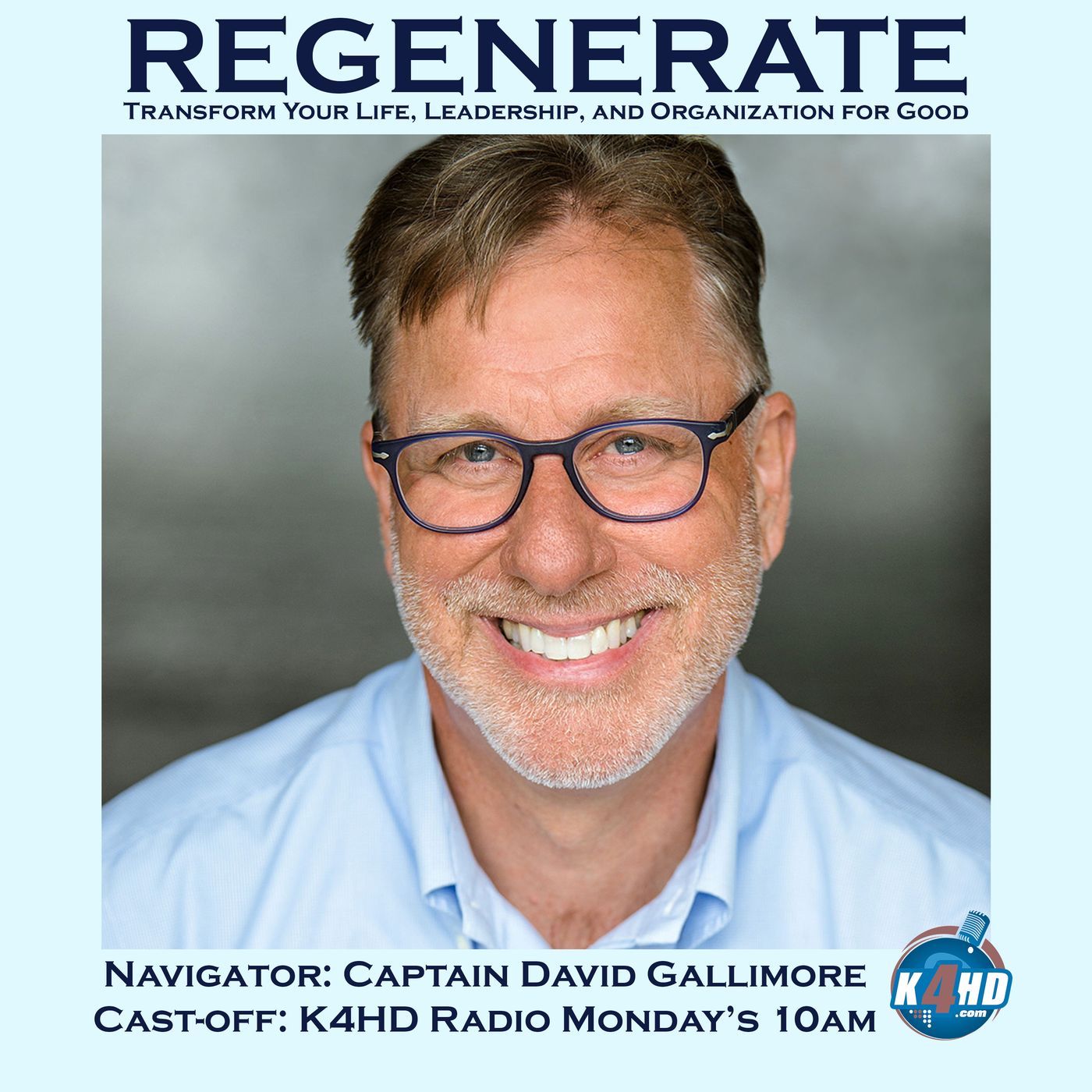
REGENERATE is broadcast live Mondays at 10AM PT on K4HD Radio - Hollywood Talk Radio (www.k4hd.com) part of Talk 4 Radio (www.talk4radio.com) on the Talk 4 Media Network (www.talk4media.com). REGENERATE TV Show is viewed on Talk 4 TV (www.talk4tv.com).
REGENERATE Podcast is also available on Talk 4 Media (www.talk4media.com), Talk 4 Podcasting (www.talk4podcasting.com), iHeartRadio, Amazon Music, Pandora, Spotify, Audible, and over 100 other podcast outlets.
Become a supporter of this podcast: https://www.spreaker.com/podcast/regenerate--6862974/support.
0:17 Ahoy! Captain David Gallimore welcomes you aboard the Regenerate Show, live Mondays, 10 a.m. Pacific on K4HD Radio at K4HD. com. Now, here's your host, Captain Dave, your personal regenerator. All aboard! Ahoy, friends, and welcome to Episode 29 of the Regenerate Show. I'm Captain Dave, your personal regenerator. This show is all about creating a safe space for our guests to share vulnerable, true, not performative stories about the messy middle of their personal, professional, and organizational transformation. Stories I believe we need now more than ever to inspire us to grow into our better selves, improve our health and those around us to become more resilient, to better handle little things like AI, climate change, and economic and political uncertainty and disruption, my guests and I seek to point to hope and provide simple strategies and tools you can use today to become someone who brings more resilience, purpose, and authentic energy to the people you love.
1:26 And when you're ready, to our planet, our only ship. So what is regeneration? I believe it's the underlying nature-based framework of this show, and it draws from 3.8 billion years of life's own logic. It's all about restoring vitality across every living system, ourselves, our families, our teams, and our communities. And I believe when we work together, we can move beyond mere sustainable living, doing no harm, to regenerative living, becoming like a healthy forest, nurturing life throughout the seasons, resilient, abundant life. For example, yesterday, I skippered a sailing excursion on Commencement Bay outside Tacoma, Washington. We experienced seals and sea lions. All sorts of water birds, porpoises, sadly, no orcas. They took a different path down the narrow strait on Sunday. And toward the end of the cruise, I facilitated a thought-provoking conversation, at least I was told it was, with a group of three new retirees who are interested in giving back to society in the next chapter of their lives. They were really curious about how to live more regeneratively. Whether you're a longtime crew or joining for the first time, welcome. And I hope you discover something today that changes how you see yourself and what's possible to improve the health of our people, planet, and profits. If you're inspired, I invite you to share this show with someone who needs it and consider being a role model and a teacher of regenerative living. Here's our promise. First, we're going to have some fun today.
2:58 When we're laughing, we're learning. Second, I hope to leave you inspired. And third, to leave you with just one thing that you can apply before you sleep tonight. So grab a pen. transformations happen here. Our theme today is a bit of a longer one, so hang in there with me. If you don't design your life, it'll be designed for you. And I just, with my guest's help, we came up with the value of nature's principles for leading well. So if you don't design your life, it'll be designed for you. That I have experienced in my life, perhaps you have as well. So what if the design principles that heal a watershed are the same ones that build a steady leader or a resilient team. This week, my guest, Zsávon Kérby Berdianovic, is a regenerative land and life design consultant. He's a strategic designer and facilitating partner.
3:53 And he joins me today to make sense for the case of ecology as a master pattern from which we can learn. From catching and storing energy to valuing the edges most people ignore. Javan walks through the pattern language he uses both to redesign farms up to 65,000 hectares, as well as to facilitate leadership work with organizations like the 30 Birds Foundation. And he argues that ecological literacy and leadership literacy are cut from the same cloth. So I first met Javan as a fellow FloraStorm regenerative leadership journey leader. and just really enjoyed his mind, how his mind works, his authenticity. We've had a couple discussions since then, and I invited him to join us because I think as we now get into the second half of 2026 of this show, I really want to focus a little bit more on regenerative people and regenerative role models like Gabon.
4:57 So he's a regenerative land, life design, and strategic design and facilitation partner consultant. at All Points Design, and javankirby.com. He's taught over 2,500 students through Oregon State University's Permaculture Design course and his online e-learning platform, regenerativeliving.online. Maybe Rebo, our producer, can add some of those links as we get into the show. He's created the values-based decision-making framework and applies it alongside voice dialogue and conscious leadership facilitation with both individuals and organizations. He's designed regenerative land projects from a third of an acre to over thousands of hectares across Canada, the US, Cuba, Kenya, and Uganda. And finally, Javan facilitates strategic planning and leadership development for organizations, including the 30 Birds Foundation. Please welcome to The Regenerate Show, Yvonne Kirby-Burnanovich. YVONNE BURNANOVICH Hello, Captain Dave.
5:57 How are you doing? CAPTAIN DAVE BURNANOVICH Hey, welcome, my friend. So you, I understand, are a fellow Canadian. And where again are you stream yarding in? So I was born in Calgary, Alberta, in the General Hospital. And roughly three and a half, four years ago, my family and I moved down to the Ecuadorian Andes, just outside of the city of Cuenca. Thank you. So now we have a bit of a visual. Beautiful part of the country, or part of the world I've not yet visited, but it's certainly on Margaret, my wife's, and my list of interesting places to visit. So we always like to start this show, my friend, with just a couple of questions. The first is, what's that one thing, Javan, that just lights you up?
6:42 You know, these days, because I've been so heavily involved with values-based decision-making, which is a decision-making strategy that focuses on envisioning the future. And in that envisionment, in that time travel into the future, we pull back the values of who we are. would need to be to have that future be a reality. And we use those values to make decisions. So it's one thing to say, a lot of people will call me up and they'll be like, hey, I'd like a regenerative farmer. They've watched The Biggest Little Farm, which is a big documentary, maybe five, six years ago. And I'm a vending machine and they press a button and out comes the farm. And yet when I would ask them, like, what does that really mean for you? What does having the biggest little farm in your own bespoke language look like? They would always say something to the effect of like, well, I want to live in a place that has clean air and I know where my food comes from. There's water and there's stability and security and all of these other words that have not a shred of farm in it. It's all just values.
7:42 It's quality of life. And what would happen quite quickly is I would say, well, I don't know if you've farmed before, but it's rather difficult. There's a lot of hardship to it. And generally, we sacrifice a lot of our values for the goal. And so this process of values-based decision-making flips it. So instead of having the goal penultimate, the values penultimate, and we decide what are the decisions, what are the actions that actually make sense and filter us. So on Saturday, I was running a values-based decision-making live experience. I run these monthly or semi-monthly. They're free and open so people can come and experience it. And it was so amazing to have this one student who was from Trinidad, Tobago. She was a student in another class of mine. She's now in British Columbia taking a master's degree. And she had this wonderful moment where she shared that I'm so much more aware that I have a future sense of myself.
8:29 And if I'm connected to that future sense, I will act differently moment to moment to make sure I become her. Or if I allow life to come at me, if I just allow, as you talked about, 3.8, 4.5 billion years of to press upon me in an evolutionary way, I will be determined by external forces, but I can be the sovereign. I can be the queen, the king, the king, the arch French Duke Ferdinand that directs, that creates a spark of what I want my life to look like from a business, from a relationship perspective, from any, you know, from any perspective of what that is. And I I'm still kind of, I've got a bit of a buzz still coming from Saturday because aha moments that were coming from people who had never seen the work before.
9:15 And I just love when people go, Oh, I can be more sovereign in life. So that's where a lot of, uh, excitement is coming from. Wow. That just, uh, warms my heart. Uh, and you are lit up, uh, as you, as you tell that story, your, your energy shifts as you, as you relate what happened. That's awesome. Living your Ikigai, which is, uh, an episode that I did, um, a couple of weeks ago, your reason for being. Which, when you make your work your play, it's such a gift, isn't it? You know, for me, it's one of these things that's a non-negotiable. Because I've worked with values for so long in quality of life, everything I do has a soul aspect. So, like, I was teaching a how to create a forest of food course a little while ago. and i had mentioned i had created a documentary and this gentleman in the class said oh can you send it to me so i did he sent me an email back maybe a week later he's like do you do anything that isn't soul focused and i was like well no like why like i don't i don't understand the question and i think that's when like When you challenge the story that is native to the world, when you challenge corporate consumer capitalism, that you are a consumer first and foremost, you're not an individual. Your needs have to be transacted through money or through some sort of exchange. You don't have a sense of how you have connection to others in a way that is beyond just what I give and what I receive. Then you're at a consumer corporate level. And when you step out of that, and when you step
10:46 out of your end of suburbia moment, and you step out of oh, there is finite amounts of non-renewable resources on this planet, and it has an effect to how we live every single day. And it is a giant snow globe. And anything we do within this giant snow globe, this flying spaceship with talking monkeys on it, affects everybody else. You think differently, you act differently. And I find so much similar to when we met, you find a tribe of individuals who have awareness and have a hungry mind for these types of things and this type of work. And so Yeah, it comes with the territory now in terms of how I operate. Oh, my gosh. I mean, I'm having a bit of PTSD from my own corporate consumerism identity. So I'm the kind of guy that has this executive title. I'm the person that drives this Lexus. I'm the person that flies to these countries on these kinds of Delta Airlines business class. I'm the person that eats these kinds of nice foods. And thankfully, my wife, Margaret, who's Native American, we've been married now for 35 years, coming up on 36.
11:58 I'm still in. Training, but she was way ahead of her time and was constantly asking me, what do you really value? And what is your soul speaking? And I'm going, soul, what? No, I've got to just deliver these results for this company like IBM or Boeing or Capgemini. And it wasn't until I personally got laid off and realized that there was such a deeper way of living than what I was living. And I kind of woke up like Neo in the Matrix, if you remember that movie. So good on you. Second question I'd like to ask you, and then we're going to deep dive on a few of these topics of our theme for today's show. So Tell us maybe in about five, six minutes, what are those handful of things that really have defined you? What's your origin story, Yvonne?
12:50 My goodness, there's so many inflection points, who we are and how we operate. I think because I had such a deep connection to the outdoors, I grew up in Calgary, Alberta. I was on the eastern slope of the Rockies. I was put into Boy Scouts very young, and I had just an exceptional group of leaders there. And so this group of men who were like airplane mechanics, police officers, they were basically the village people, right? They were every single aspect of the village people. They would consistently bring us out to the woods. We would consistently do like gourmet camp, or we would do survivor camp, or we would do Ewok camp, or we had to live in the trees for the weekend. But they continually challenged us to...
13:35 find who we were, to find what we knew, and to find how we could become initiated people. So this is one of the interesting things about our society is that physiologically, when we're born, we don't have the ability to take care of ourselves like a number of other animals do, right? We don't have the instinct or the ability. And so we need caregivers to take care of us. We need caregivers to help us to the point where we're stable, at least physiologically. If not, for most of human history, mentally, spiritually, and also societally. So many of these Indigenous societies would have fatalistic rights of initiation, of passage into adulthood. We don't do that. And so I was so grateful that I had a group of men who continually challenged me, asked me to do hard things, go and do the hard things and go, oh my goodness, I can do hard things, to the point to where voluntary hardship became a value that I held. So be it on a daily basis, a monthly, a seasonal, a yearly basis, to invite hardship into my life. And that might be going back to Seneca's conversation of, you know, have the roughest of cloth and have the simplest affair, or it might be, we're going to remove, you know, a meal a day, or it might be, we're going to try and go and hike up the mountain for only the reason that the mountain exists. But I think so much of that got crystallized with this group of leaders who was like, let's see and test these young men, these boys at the time, against themselves to see how far they could go. And I've used that ever since.
15:08 Not to mention, it's like, now I can name plants. Now I can work with ecology. At that point, I just knew what kind of plants burned well. Because when you're young and you've got yourself and your buddies and you've got a box of red fire matches or red bird matches, that's really the focus of why you're out there. But it laid the groundwork on such a like familial values. It's like that old saying, it's like, don't seek the men of old, seek what they sought. And I feel like what those leaders were doing implicitly or explicitly, where they were setting the framework, the groundwork for those of us that had come from, and let's face it, this is a relatively soft period of life when we take a look at the historical conversation of what it was like to be human, but to bring some challenge to us so we could come to ourselves, we could walk ourselves home.
15:54 Okay. I don't even know which thread to pull first. First of all, I'm a student of the Stoics. It sounds like you are as well. Yeah, for sure. This is the thing, and you know this, once you become interested in life, it's not like music. It's not like, ah, I only listen to country or I only listen to rap. It's like, where are lessons found? Where can we find insights, education? Where can we find, you know, principles or generalities that are the grand unified theory or the theory of everything, the gut and flow theory of how we approach and do things? So, For me, I'm always looking for the lessons in the conversation. It goes back to what Einstein said. The number one decision we can make is, is the universe a hostile or a friendly place? If it's friendly... We can learn from every moment. It doesn't mean every moment is without pain.
16:44 It just means that we can learn from these moments. We can be present to these moments. I've got a major family crisis that's happening right now. My husband of only a year and a bit, we've been together for 12, was told that he could die at any moment from a heart condition that we don't know what's going on. And so either I can be present to that every day, I can pull up values like the present is precious, be present. I can pull up how I want to be in this moment. I can use this as involuntary hardship that every day I have to be present to him and myself and how I feel about this. And what am I learning today? What am I building today? Because I may not have agency over outcome. And this is what happens to all of us with aging, with anything we deal with, is that we may not have agency over outcome, but we do have agency of response.
17:34 And this is where so much of Are we living in a degenerative, generative, or regenerative mindset? Not just work, but mindset. Degenerative, less than before. Generative, the same. Also called sustainable, because if we're staining a note, it's the same note. So sustainability shouldn't be our focus. But regenerative is more of what we're looking for. Do I want to have a better relationship with my husband? 100%. Do I want to be closer with him? 100%. Do I want as. Long of a track as I can, sure. But we may not get that. That may not be there. With all the advance of modern science, with everything we know, there may be a compendium of complications that don't allow that. So what do we do in the interim? Be more present.
18:17 Be more in a values-based way of living because we don't have control of outcome. And talking to some of the people that we were speaking about that don't feel this way, a lot of those are family members, right? And they go, well, have you done this? And why aren't you doing that? And why, like, It's about the quality of being with somebody regardless of where they're at and what you do for them in those moments. It's every problem every person who's ever been in a relationship has ever had. It's not what we say. It's how we say it. And so it's not the issue. It's how do we be present with the largest calamity anybody could deal with outside of, I think, losing a child and then be present to that throughout the entire thing and then go, okay, I love you. I'm going upstairs.
18:59 I'm about to do this interview. And I'll be with you in an hour. And besides that, what else can we do in this life? His first name? His name's Todd. Todd. Well, I do believe that we're all energy in different forms. But I also do believe in the power of prayer. So I will add Todd to my prayers. And I hope that everything that you just said gives you the strength to be there for him so that then he has the strength to get healthier faster. It is... it's a terrible bit of news and how you're showing up, but I'm sure you're putting your best studio face on as well. And there's good times and bad times. And, and I just, I wish you great strength and learning and, as you said presence what a powerful way of being and this will be put to the test this simple but not easy idea of staying present because it's so easy to have a fear of the future or regrets of the past and that's not going to solve any that's not going to solve Todd's challenges at all.
20:10 No, no. And it goes back to so much of what we were talking about when we were conceiving of this episode, this conversation, like where are the ecological principles that can serve us can be present. And I think many people can relate to this. Most of our pets live in the moment. Most of our pets are living in exactly the moment they're in. And if something happens, if they get yelled at, or if they get pulled by, or if another dog comes by and they start to become the territorial entity and the role that they play in our lives, they shake it off, right? They have that moment where they go, that's true, and now I'm still present. And what we know about trauma-based somatic release processes is a lot of these processes mimic this type of shaking conversation, this removal of moment. And it's an interesting piece where, like, Todd will never not be with me, as you know, when you're married. You chose one person.
21:06 You're like, you're fun. It's great to be with you. Why don't we do this forever? Let's have a sleepover for life with our best friends. And yet, life still goes on. It's the life-threatening laundry dilemma that I've been talking about with family members. How can the worst thing be over? How can the sword of Damocles be over us all the time? And yet... I still have to do laundry. There's a great injustice in that. But this is still happening. Yes, and laundry still happens. The world still turns. 99.99% of all life that has ever existed on planet Earth is dead. It's a wild statistic. 99.99% of all life that has ever existed on planet Earth is now dead. We are the next iteration of this blip that comes up in this lifespan that ends with So again, pulling back, what are the lessons of four and a half billion years of R & D? What are the lessons of the animals that are an expression of ecology? Be present. Right now, somebody is suffering. We'll be with that, right? We'll be compassionate to suffer with. Great.
22:09 Be present. And now I need to transition into something else, okay? My love for him doesn't, my connection to him doesn't, my conversation with him doesn't finish. But now I'm present with you. And all that I am and all that I've learned from him gets to come here and gets to be shared with you and anybody else listening who is also dealing with heavy, frustrating, friction-filled, terrible things. And I think that goes back to the conversation. I trained with Dr. Gabor Maté years ago, who is this amazing Canadian physician, and came to the realization that it's not why the addiction, it's why the trauma. It's not why are we addicted to something, it's why is there a hungry ghost inside of us that is constantly craving for something to be filled. And his conversation was such an important one for me because it was about being present, but also being aware. So it wasn't just present in the moment. It's what is influencing me from the past?
22:59 What am I still holding on to that doesn't make sense? And so for us as individuals, for leaders who are stepping into conversations that could shape millennia or at least generations of people, are we coming at it in a present moment from a first principles conversation that allows all of us to be present in the moment? Or are we walking in as somebody who still has an activated eight-year-old or an activated 12-year-old or, you know, all these parts of us that are running the show and running the ship. And that's where I think that ecology piece of like, oh, the dog can shake, right? We can shake too. We can be present in these moments. So as a pet owner, my wife and I had the blessings of our daughter who wanted a Siberian Husky and we put her off, put her off for years.
23:47 And then In high school, she wrote this wonderful essay of how she was going to be a responsible dog owner. And eight weeks later, we had this little furball hand-delivered to Sea-Tac Airport. And it changed our lives. And I know exactly what you mean by animals and perhaps dogs especially, because that's my experience anyway of it, is they have like what Ted Lasso, the Apple TV show, where he talks about how the memory of a goldfish, which is about 10 seconds. Yeah. And Asha was a terrific role model for staying present. And I miss her every day. I have a five o'clock alarm that comes off every day. And I give a little prayer to her and reflect on some of those principles that she modeled, including the downward dog. If I had just stretched as often as she stretched or the upward dog, whichever one she did, I'd probably be in much better health today. I think also this notion of balancing the day-to-day, like doing your laundry, but also then being the best nurse, helper, person of service to Todd and yourself. That's the other thing that's important with regeneration is we have to give a little bit of time to ourselves to put our own masks on first. Otherwise, we're just not going to be able to support those around us, but that's hard, especially when you're dealing with what you, you and Todd are currently
25:20 dealing with. So bring this back to now our theme. And, and if you're willing to keep exploring this conversation that we've been having about, you know, how you're showing up best, you can be with, with Todd. I would, I would love to kind of integrate our theme with, with a little bit of this life, throws you a curve, I mean, a really serious curve. And so how are you thinking about designing your life? Otherwise it will just unfold as it does without conscious design. Are there any design principles that you have been able to hook up with, with Todd that you'd be willing to share?
26:01 Oh yeah. Yeah. Because when you work in values-based decision-making or any of these other tools or processes, They're living tools. They don't stop because something happens. It goes back to what you were saying at the beginning of the show. Dan Gilbert said that human beings are works in progress that mistakenly deal with. There is no end point. Depending on your beliefs on the afterlife and death, there may be multiple non-end points that come up. But regardless of that, we are always in a state of being able to receive, process, and respond to information. And What we know about the brain, what we know about how we work, really speaking to, it's Lisa Barrett Feldman, I think, the neuroscientist who really crystallized this, this concept, this conversation of it's about perceived resources and demands. You know, that old model of the triune brain model that's been debunked multiple times and we still use it all the time. It's great that we're letting go of that because I think it didn't give us as much agency. And this allows us quite a bit of agency. Not only is it, what are we resourced to do, but what is our perception of reason?
27:12 And we know this again by taking a look at ecological principles. So if you've got, if anyone's ever been around or has young children, they believe they can do anything. And they do a number of remarkable things because of that. Nobody can catch the chicken in the yard or the roost in the yard with the big spurs. Picked it up fine. Totally fine. No problem. What are you talking about? So there is this piece about how do we stay present to ourselves, but also how do we have an awareness that we might be able to direct our response? Instead of going to where the brain normally goes, which is quick energy consumption and low energy consumption, which is let's go to what we've done before, which is reactivity.
27:55 When we want to move into a state of creativity, as Todd and I and his daughters and all of us have been doing for now coming up five months, is reactivity. Well, what do we have at our disposal? We're all incredibly kind, incredibly patient, incredibly able individuals. We have a tight connection. We have the ability to think small, medium, and short-term. Small, medium, and short-term. Small, medium, and long-term. That was Freud. That was Freud. We have the ability to be present to how we feel as we feel it and to share it with each other. One of the pieces that we've lost in corporate consumer capitalism is that we all feel that there's no one to speak to unless we transact with them. And yet when we do share with people, as I was willing to do so today, and as you believe me, when we are vulnerable, we get to connect with people deeply on a level that allows us to feel human again, that combats the loneliness epidemic, that combats all of the disconnections we have in our lives. So for us, tangibly, You know, one of the first values that came up for me is that the present is precious. Be present. And so this is, you know, if Todd's in a moment and a conversation, if he's having a mini attack, if he's feeling frustrated, sad in a place of despair, I'm just present with him.
29:13 I don't have to change him. I don't have to make him wrong or right. I can just be with him, which for an Albertan, for anybody who doesn't know about Albertans, it's kind of like Texas and Montana had a one night stand, you know, bigger, better buck, lone rug, a woodsman, get her done. very difficult for my, my family of origin upbringing. And so that process of being present with him was learned day by day during this, experience. That was a hard one in terms of just like, okay, I'm going to be present. What do I need to be present to? And this goes back to some of the values-based decision-making work. I was just teaching this on Saturday. We're all juggling balls. And some of these balls are glass balls and rubber balls. And most of us have never thought about this. Some of those balls, if they drop, they'll bounce and we can pick them up. Some of those balls, if they drop are glass and they fracture or they crack and they become more fragile, right? They can become more fragile. And so this idea of what is a rubber ball and what is a glass ball.
30:08 So my health is a glass ball. Todd's health is a glass ball. Our relationship is a glass ball. How I feel about this process after whatever happens in this process is completed is a glass ball. I don't get to go back and rehab this time. So all of those are my glass balls. So my health is also in there. That also means, to your point, are we putting on our mask first or are we putting on our mask when we're able to? And again, calling back to some of these incredible individuals I've been trained by and worked with, Dr. Gabor Mate, he had this wonderful thought about compassion fatigue. And this is a wonderful thing I took into this experience is that compassion fatigue comes from a place when you are burning resources that are non-renewable.
30:52 So if you're putting on heroics to caregiver, You'll burn through that. It's a heroic conversation. But if this comes from a place of who you are, or if you transition or transform it into a place of who you are, okay, interesting. I'm in this new place where I am now a caregiver. Huh, I've never been here before. Cool. What can I learn about being a good caregiver? And it's great, just like with a dog. How do you learn how to be a good companion for your dog or a master for your dog, depending on what you're comfortable with? You're present with them, what they want. You see what they're at. You see how you can help them. So again, from an ecological perspective, when we work and we are in these conversations with ecology, years ago, I was invited into this dairy on Vancouver Island where I was living at the time. And a buddy, well, I wasn't invited. A buddy of mine brought me there and the owner was like, are you Javin? I was like, yeah.
31:44 I've heard you on podcasts. Would you mind taking a look at something? I was like, uh-oh, this sounds like unpaid work. So we walk into the field. And they go, hey, there's this drainage. There's this little creek. There's this little watershed that runs through my property. And I wanted to turn it into pasture. Because they're a dairy, they want to turn the ground into grazing material, grazing material into milk through the animals they were working. And so they wanted to see how could they transform this? I said, okay, well, give me a sec. Go do what you need to do. I'll walk the land. I'll see what's going on. So we're going to compare, contrast and compare here. So with Todd, with what's going on, and also with our pet analogy, you're just present with what is. You're not trying to make it something else. You're not pulling from the past too much. You're not perceiving the future. You're just being present.
32:29 I'm walking this landscape. I'm looking up on the hill slash mountain beside us. I'm looking around, kind of figuring it out. And they come back and they say, so what do you think? I was like, well, I got to tell you something. He goes, yeah. I say before people were on Vancouver Island, which depending on who you believe could be five, 10, 15, 20,000 years, you know, before people were here, that mountain was here. Yeah. And that mountain, just like the roof of our house was capturing water. Yeah. And just like our roof captures water and comes down the gutter and comes down the downspout and then finds its way as it goes. So too, this watershed, this little drainage here has been here. Hmm. And when humans are all gone, because our time on this planet has a finite end, 99.99% of all life on all the planet is dead. So our time will come too. This will still be a watershed. He goes, huh?
33:22 And I said, you're not going to get rid of the mountain. You're not going to get rid of the water. What I would do is I would use what you have. I would probably fence and plant out and probably terrace this watershed into fodder for your grazing animals, your dairy animals at top. and food and medicine for you and your family at the bottom. And he sits there kind of with his mouth agape and he goes, that's the smartest thing anybody has said about this in six years and over $ 15, 000 of consulting fees I've paid. I was like, wait a second, there was money on the line here? Let's talk about this. The last guy said they should strip the topsoil, fill in the watershed and just put the topsoil back down. That's like clogging your downspout and being like, oh, the roof doesn't exist. So contrasting that to todd it's like this is what's coming to us this is the rain the rain doesn't like nature doesn't care about our emotions it's one of the things when i teach in oregon state people like what it's like that's all human made we're making up our emotions as we go we're making up what morality is the water's coming down it's it's flowing down this is what's coming to us and up so our only choice is is this friendly or hostile Is it a woe is me or woe? What can I do? Oh, well, maybe I can grow from this. Maybe I can be a better husband.
34:38 I can be a better friend. I can be a better teacher. And I think, you know, this, this will be up to the internet public court of opinion, but I think it is benefiting the people I've spoken to about this, the conversations I've had with people, they're going, you're taking so much from this. I'm like, I don't have another, I don't have another option. Like the crying comes with it. The, the emotional frustration comes with it. That's part of it. That's just You know, we have equal amounts of grief for whatever we love. If we love big, we're going to have equal amounts. And so either we put it into productive use or we allow it to bottle up like so many men in my family have about so many things. So my optionality is, do I take that water? Do I take this situation that's coursing through my life and do I use it for the highest amount of my ability? Or do I try to ignore it and damn it up and have it flood out everything? Or do I drain it away as if it doesn't exist? Those to me just aren't realistic.
35:35 We could do it, but we'd have a negative result because of it. What a great couple stories and the application to how you're approaching your current challenges with Todd. I'm reminded of what you said when we first kicked off our conversation is how valuable self-awareness is. And so that presence kind of integrating yourself what you're observing, the responses from others, including your own family that has their Alberta way of being. I can use that shorthand. You can. And how you're showing up and how the ripples might, in fact, influence the Alberta way of being.
36:20 Who knows? Certainly Todd's immediate children. I mean, what a tremendous gift to them, especially if you're able and willing to share some of that self-awareness with them so that they can learn and grow as you're learning and growing. And this is really the purpose of this fricking show. You're in the messy middle, my friend. And, and if, and if we don't acknowledge authentically where we are and then try to be a role model for different ways of, of being and ways you, you also made a great point earlier about mindset, which there's a, there's a terrific YouTube channel. that I will find the link and put it in the show notes. But this researcher from Harvard and Yale, she talks about how much of our mindset impacts not only the outcomes of health. So I just invite you and Todd to consider if the mindset can be slightly leveled up, slightly inspired. And Robin Cousins, that famous story about how he laughed his way to health, He watched Marx Brothers and all these other humorous shows. The placebo effect is very real when it comes to health outcomes.
37:38 And the research that this woman provides in the YouTube show convinced me of that. When you're working out, if you have a placebo effect there, and so on and so forth. She's got these four examples of how mindset is really such a foundational part of nurturing, a healthy way of being. A hundred percent. A hundred percent. And the great thing is, is it's completely within our control. It's completely sovereign. I remember the first time I encountered cross-country skiing and I was like, wait a second, all I have to do is buy the skis and I can go wherever I want. I don't have to buy a lift ticket as a downhill, but what do you mean? And that's what I love about tools like this is that once you have them and apply them and work with them, you've got them for life. And the ability to respond to change. That's where resiliency originally came from. Upon impact, can you come back to shape? Or the most important thing we have is the ability to find a good or a neutral mood, regardless of circumstance. Whereas, again, going back to ecological principles, entropy, high-order things becoming low-order things, the mountains coming down to the seas, the houses crumbling. Entropy is always working upon us, always.
38:53 That is a a law of the universe. So if we stop, the best we can hope for is stagnation. That's the best. What normally happens is we backslide. We backslide in health, use it or lose it. We know that for almost everything. And so when we talk about this idea of quality of life, as you're speaking to, it is that aspect of how have we focused, how have we built upon a resiliency of our mindset? How have we focused on, is it a friendly universe or a hostile universe? And We can still, and this is where I think most people lose it. I know I did. Can we be open to what we're feeling? as we're feeling? Can we be open to the heartache, the tragedy, the loss, all of it, and feel it immeasurably, exquisitely so? And I think that's where grief is so beautiful. It shows us exactly what this person means to us and for those that have passed have meant to us. And So much of the issues around grief, again, going back to my time with Dr. Maté, are about a lack of expression, about a lack of pass-through, going back to the watershed.
39:57 The water's being held and it builds up and builds up and builds up and builds up, and then we have flood. And with flood, funny enough, on the other side of floods, the same coin is drought. Because after that water has pulsated through and there's these O-gives, these pulsations of life, now all of a sudden that water is gone. And that water doesn't have a chance to infiltrate into the landscape. So much of the work of Brad Lancaster, Brock Dalleman, Zach Weiss, Sep Holzer, these individuals, these luminaries, when it comes to watershed restoration, slow it, spread it, sink it. What if we applied that to life? What if we applied that to emotions? Slow the emotions, spread the emotions, sink the emotions, feel it. Well, Javin, what happens if we feel it completely and we're destroyed by it?
40:38 Cool. Cool. What happens when we re-engage and we reignite? Why do we think that the phoenix is such a prominent myth or metaphor or who knows, in actuality, aspect of human society? Because there is always rebirth, right? Every, what is it? Every seven years, we're completely replaced, all the cells in our body, like literally. So why I say that ecological principles are so important for how we live our lives is because we are ecology. You know, the only separation in the human body is a scalpel. The only separation between us and ecology is the human mind. It created us. We're at a place now where taxonomists, these aren't the people who work in taxidermy. These are the people who classify human life. Well, not just human life, but all life on the planet. They want to rename us Homo sapien domesticus fragilis. We should be a whole different classification of hominid because we no longer can take care of ourselves without technology. Well, that's interesting. And here we are talking and people are listening through this technology and all the rest of it. It's a very interesting conversation we're in right now. And yet I find that so many of our solutions can be found back shockingly in the four and a half billion years experiment that is Earth that created us. And so a lot of what I do on the land design side is working with those natural systems. But again, you cannot work in land design if you're not going to work in life design. they are one in the same. They've been married since the beginning.
42:12 And so much of this, I think, is where people like yourself being able to host these shows and be able to share this are such a benefit and a boon to the world at large to be able to share these viewpoints, have other people go, oh, and take one thing that feels of value. I love that you have that here. In that spirit, thank you so much for sharing what you've done to date. And I hope that you I can bring you back because I think we're only just scratching the first layer of the onion of Javan. In the remaining couple of minutes, Javan, is there one thing related to your land use brilliance that our audience could maybe start to imagine, design their future, design their life?
42:57 of their physical space that would be more aligned with the laws of nature, the logic of life that would create that healthier environment. Because if we create a healthier environment, then we're more likely to be able to do the inner work that we all were talking about earlier. Are there a couple ideas that you found to be maybe not simple, but maybe not easy? And if any references that you have about how people could take that one idea forward? Yeah, there's a couple of things. I think the first thing, which is the title of the show, if you don't design your life, it'll be designed for you, for other people's benefit, not for yours, is an important one. You know, nature abhors a vacuum. There are always, you know, we talk about this when we're regenerating soil, there's always a genetic seed bank within the soil that wants to be expressed.
43:45 And there's always that expression that's coming. So I think there's a value there in being conscientious that if we decide to abstain from decision and just allow the forces around to shape us, they will. They will absolutely take us for the pickings, as you were talking about with your work in corporate, doing things that may not have been totally fine with you. The second thing is that knowing that observation, long, thoughtful, protracted observation, who am I as a person, taking all these attention aspects that we put out into the world and just turning one of them back, just one, like one out of 15, one out of 20, having a little bit of self-reflection, a little bit of self-conversation, a little bit of self-moments has an incredible value. I'm with this group of students now for eight months. We're about five months in, six months in.
44:31 We're going through values-based decision-making. And while the process of values-based decision-making has been, they've given me so much feedback on what they've done and how they've improved their lives and their relationships, finding new jobs, being a better partner. All of these great things is lovely. But they go, it was the awareness piece. It was the idea that attention is something we spend every day, and either we spend it wisely or we spend it poorly. That's full currency. And we know this if we take a look at any of the predatory social media companies. They know it. But if we start to adopt it similarly, if we observe the ecology of who we are, we can learn immeasurable insight. And if we treat ourselves as being the most fascinating subject of study, we can then go back to how do we want to design art? And where are our essential elements of life like water coming from?
45:22 Where does my emotions and where does my interest go? We have this thing called the zones of brilliance. And zones of brilliance is similar to Aikigai in that it's like, what are your perennial passions? What are your inherent gifts? And what are the problems that you uniquely would like to solve? In there, we can find a sweet spot for implementation in some way, shape, or form. very similar to what we do in land design. We're taking a look at what's the inherent characteristics of landscape. What do they inherently want to become, create, et cetera? What does the client want to do? And what is the regulatory environment? Because there is that sort of societal, social, political landscape that's over top and you find sweet spots. And so by playing the hand we're dealt, being conscientious of the rules of the game, I think over and large and by and large, the like over 3000 students and clients I've worked with with life design I've been able to make long-lasting change, or in terms of the leadership work I do and the companies I work with, we just find the ecological principles that are nested within the organization, and we work with instead of against the inherent nature of who these people are.
46:25 Well, I have to say, that sounds totally amazing. Captain Dave is frozen for a moment. I can see why. That's such insightful things that you have bestowed on us today. I want to thank you. for being here. Hopefully Captain Dave will join us back and be here in a moment. But unfortunately we are at the end of the program and he has made it back with us. This is terrific. Hey, we were just wrapping up. That was an adventure. Are we, are we needing to wind down now? Yes. We are at the end of the show. Okay. Okay. I don't know if I lost you or you, we all lost each other, but I apologize for my contribution to not being present to you, Javen. So thank you so much for a really fascinating, heartfelt, authentic, messy middle sharing. I'm so grateful that we were finally able to pull this off really truly. So gang, time is never our friend. I invite you to join us for episode 30, where I'm going to be talking specifically about regeneration and what does it really mean in this challenging era, building on a lot of what Shaban has shared. So next Monday, 10 a.m. Pacific, 1 p.m. Eastern, 6 p.m.
47:49 CET on k4hd. com or on your favorite podcast platforms. Thank you for investing your valuable time on behalf of Shaban, of Rebel, our producer, and our entire Talk4Media team, stay healthy, stay safe. We need you. We're better together. Now, let's go regenerate. Thank you for listening to Regenerate with Captain Dave on K4HD Radio. We invite you to give yourself grace and grace the messy middle. See you every Monday at 10 a.m. Pacific time. Until then, you got this.


