
What Gets Measured Gets Done: How Interface, Inc. is Transforming to Become More Regenerative

 iHeartRadio iHeartRadio
 Apple Podcasts Apple Podcasts
 Spotify Spotify
 Pandora Pandora
 Youtube Music Youtube Music
 Deezer Deezer
 Spreaker Spreaker
 Podcast Addict Podcast Addict
 Castbox Castbox
 PocketCasts PocketCasts
 Castamatic Castamatic
 Goodpods Goodpods
 Overcast Overcast
 Podurama Podurama
 Podverse Podverse
 YouTube YouTube iHeartRadio iHeartRadio Apple Podcasts Apple Podcasts Spotify Spotify Pandora Pandora Youtube Music Youtube Music Deezer Deezer Spreaker Spreaker Podcast Addict Podcast Addict Castbox Castbox PocketCasts PocketCasts Castamatic Castamatic Goodpods Goodpods Overcast Overcast Podurama Podurama Podverse Podverse YouTube YouTube
Can a polluting, industrial factory begin to act like a forest? In 1994, Ray Anderson, CEO of the carpet-tile company Interface, Inc., read a book that hit him like "a spear in the chest". He set out to transform a petroleum-based business from the inside out.
We'll explore how Interface moved from being a traditional, extractive manufacturer to being a regenerative corporate role model.
We'll also explore the challenge: if you can't measurement improvement, isn't it just a nice idea?
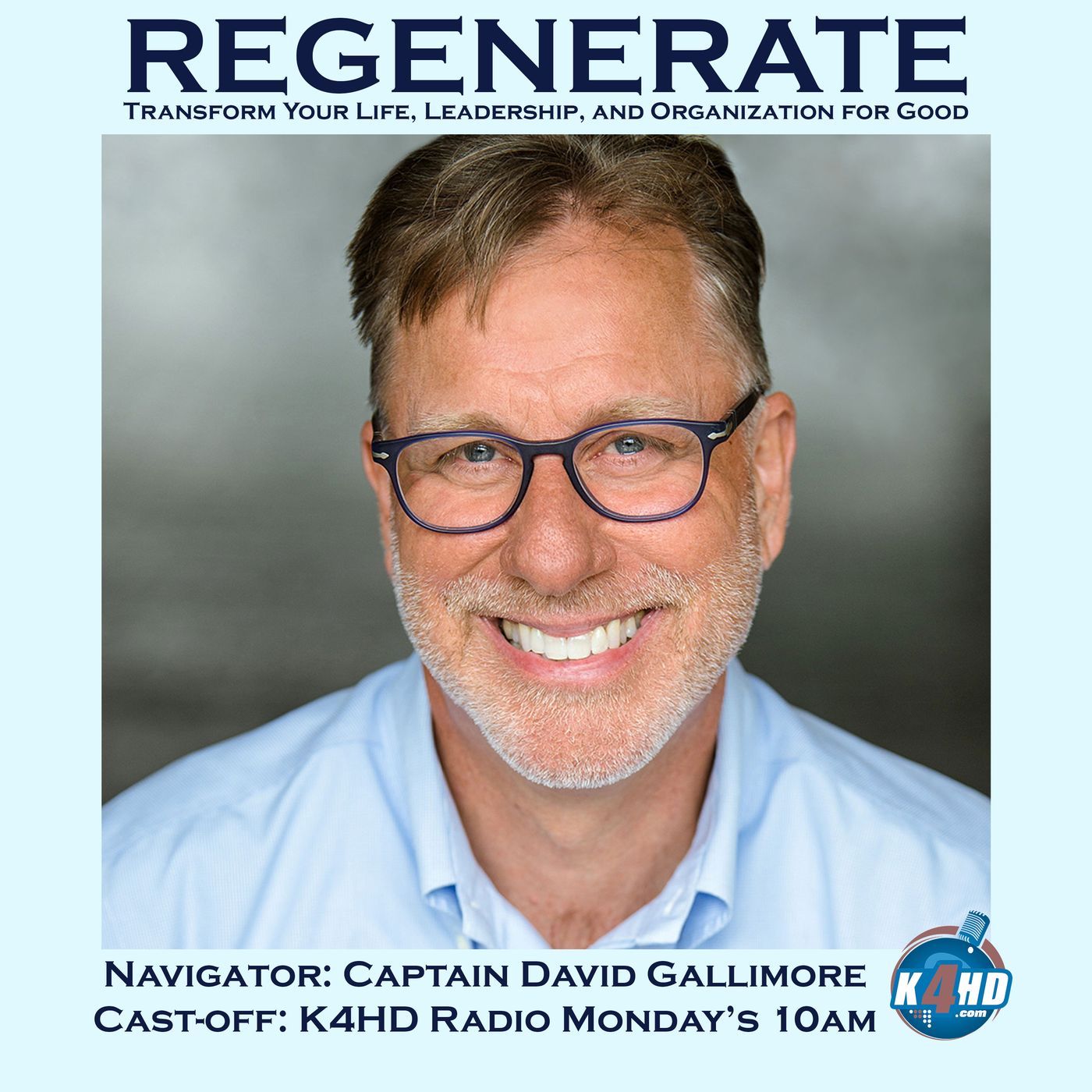
REGENERATE is broadcast live Mondays at 10AM PT on K4HD Radio - Hollywood Talk Radio (www.k4hd.com) part of Talk 4 Radio (www.talk4radio.com) on the Talk 4 Media Network (www.talk4media.com). REGENERATE TV Show is viewed on Talk 4 TV (www.talk4tv.com).
REGENERATE Podcast is also available on Talk 4 Media (www.talk4media.com), Talk 4 Podcasting (www.talk4podcasting.com), iHeartRadio, Amazon Music, Pandora, Spotify, Audible, and over 100 other podcast outlets.
Become a supporter of this podcast: https://www.spreaker.com/podcast/regenerate--6862974/support.
0:18 Ahoy! Captain David Gallimore welcomes you aboard the Regenerate Show, live Mondays, 10 a.m. Pacific on K4HD Radio at K4HD. com. Now, here's your host, Captain Dave, your personal regenerator. All aboard! Ahoy! And welcome aboard to Regenerate. I'm Captain Dave, your personal regenerator. This show is a safe harbor for real stories. about the messy middle, the part of transformation that nobody really posts about on social media. It's too performative, in my opinion. Economic pressure, global uncertainty, frankly, AI that's reshaping the ground under our feet. These are all challenges in the messy middle. But you know what? You're not sailing that alone. I'll be my own guest today, and I'll continue on this theme of regeneration. My definition of regeneration is it draws from four and a half billion years of life's own logic, where we can restore vitality across every living system. Ourselves first, our families, our teams, our communities.
1:27 And when you're ready, our planet. We're endlessly renewing. We're figuring out how to become more resilient and how to keep that abundance thinking front and center. So whether you're a longtime crew or joining for the first time, welcome aboard. So here's my promise. We're going to have fun. And I believe when we're laughing, we're learning. Now that's hard when I'm my own guest, but I guess I get to laugh at my own jokes. Number two, believe you inspired. And finally, number three, believe you with just one key takeaway that you can apply before you sleep tonight. So grab a pen. Transformations happen here. So today's theme is what gets measured gets done. And in particular, focusing on a company that I discovered about four years ago. It was founded by Ray Anderson. It's called Interface. And we're going to take a look at how they've been transforming from being a polluter, a plunderer, I think Ray Anderson called himself, of manufacturing commercial tiles that go into buildings and other organizations, becoming a more profitable and regenerative business.
2:45 So the question that they were starting to ask, and we're going to take a look at how they're doing and answering that, is how could they become less polluting, more sustainable, and ultimately becoming more regenerative? And Ray asked the question, how could a factory look like a forest? So he had this spear in the chest moment when he read Paul Hawkins' book about commerce, and the planet. And he, at that point, really set out to transform his petroleum-based business from the inside out. So we're going to explore how they've moved from being a traditional extractive manufacturer, producing an unrecyclable product, to being a regenerative corporate role model. Now, Interface, I've since learned in doing research for this episode, that measuring themselves against what would a forest do in terms of cleaning air and cleaning water and regenerating the environment, it's still aspirational. They're still trying to figure out what does that really mean and how do they scale that?
3:50 So we'll talk about the challenges that they're facing because I think that's the messy middle. And I hope this inspires you as a leader of your business to be able to think of a plunderer and polluter by Ray Anderson's phrasing and make a pivot develop a roadmap and measure themselves against that roadmap and make progress, then maybe I can do it too. I think about Roger Bannister, who is the Brit who ran the four-minute mile. He broke the four-minute mile. Before he did it, all of the experts said, That was the physical limitation of human beings.
4:31 It couldn't be done. We couldn't break the four-minute mile. But a minute after he did it, people realized, well, if he can do it, then maybe I can do it. And it wasn't very long before that four-minute mile record that he broke was broken again and again and again. We human beings, when we see something as possible and we want that, it's remarkable how we organize the resources and focus our attention to make that happen. So if you, your team, or your organization truly want to help create a healthier group of people and planet and profits become more regenerative, I hope that this conversation both inspires and provides you the roadmap. So some of the key milestones.
5:19 Ray Anderson founded Interface in LaGrange, Georgia in 1973. And the breakthrough really was this aisle system, rather than rolling out large carpet that had to be customized to fit, the carpet tiles just could be added almost like a Lego building block, but horizontally. They did use a lot of glue. And so the biggest challenge that Interface had, not only in the production of the tile, which back then was a petroleum-based product, but also if one of the new tenants of a commercial building, think of a skyscraper or a mall where, uh, these carpet tiles were being glued to the subfloor. They, uh, had to literally scrape the carpet tile, uh, and the glue. And then they had to use toxic products to prepare the surface for the next carpet tile. And so they couldn't recycle any of that. So in 1994, uh, Ray read the Paul Hawken book about commerce and the planet. And it was really this spear in the chest moment. And it led Interface to target three areas, its factories, its products, and its suppliers. So in 1996, after quite a bit of discussion, not so much action, but a lot of planning and discussion, Interface starts to calculate its greenhouse gas emissions.
6:54 So this is the start of what gets measured gets managed, which is a phrase that I learned from Alan Mulally. And I'm trying to think of the origin of that phrase. It'll come to me in a moment, but one of the early consultants of management leadership training coined the phrase. We'll put it in the show notes, so that'll get me off the hook. And if I think of it between now and the end of the show, I'll let you know. But I learned what measure gets managed and what gets managed gets done from my mentor, Al Malali, who turned around the Boeing Commercial Airplane Group and then turned around Ford Motor Company. So their Mission Zero program was intending to set a goal of zero negative impact on the planet by 2020. And they introduced a re-entry reclamation and recycling program during that time as well. In 2012, They created a program called Net-Works, Net-Works, with Aquafil and the Zoological Society of London, where they were buying discarded fishing nets from some of the world's poorest communities and recycling them into carpet yarn. Very cool, right? Somebody's waste product, fishing nets, now becomes input into a manufacturing process. In 2016, Interface introduced the Climate Take Back initiative. with primarily the aim of reversing global warming, climate change. And around the
8:26 same time, factories of forest began to be a gleam in their eye. And it really grew out of Ray Anderson's question of whether his factories could ever perform like the forest. In 2017 to 2018, the proof positive prototype tile was developed using plant-derived carbon rather than petroleum-based carbon. Turns out, trees... and algae and all sorts of other plant-based products that nature grows are sequestering carbon. It's a remarkable thing what nature does. So it takes our CO2 out of our breathing animals, other animals that are breathing oxygen and other gases in the atmosphere, fires that produce carbon, carbon dioxide, and other chemicals. So the trees and the kelp and the algae and grasses, all of these plants are sequestering carbon. So there's less CO2 in the atmosphere.
9:35 So the proof positive prototype, it was designed to help remove CO2 in the atmosphere after the tile is made. So it became itself sequestering carbon. And they set a goal in 2018 to be carbon negative by 2040. So what's really cool about when you measure things and you're focused like a laser beam and a line as a team on what really matters, in 2019, mission zero was declared a success a year early. So the carpet tile carbon footprint at that time was down 69%. Global greenhouse gas emissions were down a whopping 96%. And all the factories at that time were running on 100% renewable electricity.
10:26 So they declared every product is carbon neutral. But the truth is, and I think this is part of the challenge in our industrial and kind of capitalist society, is that often to declare carbon neutrality, businesses are relying on carbon offsets. And what is a carbon offset? Well, if a company is supportive of say reforestation and pays for people to replant trees, they can gain a carbon credit. And there's a whole industry that has been, has sprung up, pun intended, and is growing quite quickly to find projects that are legitimate projects that would likely not exist if an organization like Interface, you know, Microsoft, Google, other companies are funding these carbon sequestering projects. They're funding technology innovation related to sequestering carbon or to prevent carbon from being emitted into the atmosphere or methane. So things like scrubbers and containment technologies. And now there are some less honest carbon projects offset programs where some companies are paying a company to say that they're getting credit for a forest
11:56 that's not going to be cut down. That seems a little bit gaming the system, right? If the forest exists and it's doing the job that society needs it to do, and it's not clear that that forest would be cut down by somebody, to be able to claim a carbon offset for keeping that forest intact, I think is not honest. There is a little bit of this fungibility in carbon offsets, which is why when we hear in a few minutes the rest of their chronology, they identified that as a gap that they wanted to close. So in 2020, Interface created the Embodied Beauty program, and it's the first carbon negative carpet tile collection. So by 2021, Interface became the first flooring maker globally to get its 2030 science-based targets validated by SBTI. So this is a third party, a kind of a credentialing organization, almost like the good seal of housekeeping, if you're aware of that in the United States.
13:06 And SBTI has a criteria that they use to evaluate the veracity, the truthfulness of organizations' targets, carbon neutral and other science-based targets to improve the health of our communities, the air and water quality, as well as other targets related to helping improve the health of our planet. So here's the good news in 2024. As a result of measuring how much they're using carbon offsets, they created this all-in strategy and interface stop buying offsets, which, by the way, was not cheap. It cost them up to $ 2 million a year. And they put that money instead into carbon storing materials. So again, innovation can be really, really helpful when it comes to how do we measure and then manage what we measure to actually move our initiatives forward.
14:05 So if you're finding this useful information, I invite you to join the Regenerate community on Substack. It's regeneration in real life. where we go deeper into these topics. The next up is a short commercial about some of the work that I do in the world. And when we'll be right back, we'll talk about some of the principles related to what's measured, gets managed, gets done, and how the financial metrics have shown up. Look forward to seeing you soon. You're listening to Regenerate with Captain Dave, your personal regenerator on K4HD Radio. We'll be right back. Are you feeling overwhelmed?
14:53 Are you ready to regenerate and live the life of your dreams? Start the transformation now. Call Captain Dave at 253-237-2558. Stop overthinking. Again, call 253-237-2558 or go to regenerativeworldgroup.com to book a free, no obligation clarity call. Let's get back to regenerate right here on K4HD Radio for more life-changing transformations. Here's your host, Captain Dave, your personal regenerator.
15:36 Ahoy and welcome back. So if you're just now joining us, we've been exploring what gets measured gets done and how Interface, a commercial carpet tile company, has been transforming itself from being a polluting manufacturer to being a highly profitable and regenerative business. So I mentioned before that Interface has been on this journey of transformation and it's not been for the faint of heart. And I can only imagine because I'm trying to be a more regenerative leader and a more regenerative business. And if you've been a part of these episodes, you know how fraught that can be. Shifting one's identity and asking hard questions and making at times, challenging choices about where do I spend my time and my attention, which is, I think, even more valuable than time, especially if you're neurodiverse, ADHD, like I am. Where do my wife and I spend our money and where do we invest our money? Because how we spend and how we invest literally can create the world that we either want or that we don't want, depending on who we support.
16:52 with our dollars and our consumption. So, you know, one of the principles behind metrics is to measure the critical view. And I'll give you an example of what not to do. So when I was at Boeing, one of the initiatives that was brought into the company was called Balance Four Card. And just imagine, you know, hundreds of thousands of people getting an opportunity to hear and see at the top level of the balanced scorecard, you know, what really mattered to the executives, what really mattered to our bosses. And the purpose of balanced scorecard was then to decompose across the rest of the organization from the top down, how would we measure individual organizations and divisions and within that teams and then within the team, you know, the individual employee.
17:48 So the idea was to have it cascade these larger goals and objectives that were defined by the executives from the top down. And how would each of us do our work and measure our work such that it would tree up in support of those overall metrics? So in concept, it makes a lot of sense because we all know that if we're more aligned ourselves with something that matters to others, as well as to ourselves, but we want to be part of something bigger than ourselves. It can really bring a lot of focus and then a lot of momentum. And with focus and momentum, you can create more easily and certainly more reliably and perhaps even faster the results that really matter, the outcomes that really make a difference. But the challenge with how Boeing implemented balanced scorecard is we had I hope you're sitting down when I say this, because it'll shock you. We had 51 balanced scorecard metrics. I know, crazy, right? In hindsight, and what I've learned since, is maybe a handful, seven, six or seven metrics. More than that, it's really, really hard to keep people focused on that. They wind up being so diffused in their focus. It's impossible to manage to 51 metrics. And as a result, people lost faith in the balanced scorecard. And they realized that, yeah, this was
19:21 just kind of a make work exercise, you know, some corporate program that on the surface of it seemed like a good idea, but the implementation of it was, was really quite damaging. And when people lose faith in measurement systems, they wind up, you know, saying, yes, they're going to be good employees are going to, you know, wave the flag and Salute and do the right things that their manager wants them to do, but their heart really wasn't in it. And so what I've learned from Interface is they did a much better job at producing the critical few metrics. Now, I'm still in the process of looking into that, but my initial research has shown that what gets measured gets managed and what gets managed gets done.
20:07 And as a result of their focus, on the critical few, they've actually been able to move the needle. So let's talk now about the specific results, the financial results, because I think that's an important part of this mission of regeneration that I'm on. It's about improving the health of people's purpose, themselves as people, the planet, and then profit. And if we don't have profit, we're not going to be able to reinvest in people's learning. We can't innovate and invest in innovation. Yeah, we really struggle without profit.
20:49 You can't fund your organization's growth in healthy ways in balance, obviously, with people and the planet. So in 2025, they had a record year sales of 1.3 $ 8 billion, up 5.4%. Their net income was up 33.5%, and their earnings per share of $ 1. 96 was up 32%. In Q2 2026, the sales rose 5.4%, and their full-year guidance was raised to $ 1. 45 to $ 1. 48 billion. Now, full disclosure, about just over a third of of the percentage of improvement in the quarter's margin, so 393 basis points, came from a one-time $ 15. 6 million tariff refund. Other bits of metrics that they measured included the great places to work metric, which I think is a very interesting overall view of the culture of a company based on the criteria of great places to work if they earn that certification. So in September of 2026, they earned the great place to work certification in every eligible company. Pretty cool. Happy employees doing something bigger than themselves together. It creates that positive momentum. It creates that flywheel.
22:22 And I think that's what Interface has been able to create that environment where people can come and do their best and most creative work. And it's the role of leadership remove those impediments and that interface is showing significant improvement, not only in their sustainability, but also their regenerative goals. So from a carbon metric perspective, they're making real progress, but it is slowing where it continues to be hard. So in 2025, the total product portfolio footprint fell by about 4%. In other words, they're producing fewer SKUs, fewer products. scope three emissions. So scope three emissions are any company or individual that provides services to the larger organization, in this case, Interface. What is their carbon footprint? That's a whole level, right, of cascading measurement. And so the scope three emissions from purchased goods fell only 2%. Now, the good news is that Interphase now offers about 450 or more carbon-negative boring options. Remember, the recycled nets from the ocean were providing new sources of their manufacturing supply chain inputs.
23:47 And 51% of their materials are now recycled or bio-based. So Interface is now more than halfway to its 2030 scope one and scope two goals. In other words, how are they showing up? How are they producing products that are going to be truly net positive rather than extractive? But those scopes are only about 3% of its roughly 400,000 tons of emissions. So they've got a lot more work to do. And emissions from purchased goods are down only 43%. But the fact that they're measuring these harder things, I think, is to their credit. Now, what about the factory as a forest? When I first heard of this idea, I thought, wow, this is amazing. So if you've ever been into a forest, A, the air quality feels amazing, and B, the sounds, the sights, incredibly calming, regenerative, if I can be so bold. Turns out I've been doing some research on trees, and I'll be sharing some of that research in the coming episodes.
25:00 But basically, if you hang out with trees in the forest, it's going to reset a lot of your own body chemistry and your own emotional resilience. And then, of course, water quality. So air quality, water quality, this kind of ethereal, just you feel better in a forest, feels regenerative. Hard to measure that. So they've been primarily piloting the factories of forest at interfaces, LaGrange and Atlanta facilities. And I have to admit that I'm really impressed that they're saying, hey, this has been really hard and we're still trying to figure this out. And they're saying that they're measuring the things like air quality and water quality, being good stewards of that same facility. acreage square footage of land as if it were a forest uh what was the factory doing against that standard against that benchmark and they've been struggling with that because each benchmark is against its own local ecosystem so some areas are are not old growth forests you know some are areas more of a plains sub-saharan you know different environments that that compose that at Forest.
26:21 And so it makes it hard to scale. There's not a lot of transferable knowledge and consistency that you take from one site to the next. And I couldn't find a factory versus Forest scorecard in their 2025 impact report. So basically they're just reporting their carbon and how is that getting better over time. So this is not easy stuff. And for those of you business leaders that are listening to this, Just know I have a lot of empathy as well because I'm trying to do the right thing in my business. The fact that I'm on a Zoom call with you is me not having to drive to a studio. I've set up my own home studio. As Rebel will know, sometimes that's not as predictable and reliable, but we figured it out just before the show started.
27:17 and hopefully we haven't lost our connection. I think she would jump in if I did. So the challenges that I'm having right now is I'm teaching sailing, which is, I think, quite a regenerative thing. I graduated three new students over the weekend. I had to get in my car and drive about an hour and a half Saturday morning. I spent the night on the boat Saturday night. Yay me. I didn't drive back another hour and a half. But I then had to drive Sunday night for about an hour and a half. And I'm filling up the tank of my car a lot more than I was when we lived 10 minutes away. So I'm actually looking into an electric vehicle and seeing what I can do to really cut our carbon footprint. Now, the second-order consequence of buying an electric vehicle is what is the electricity that's producing Or what is the source of the production of the electricity? So when we lived in Dash Point, a railway area outside of Tacoma, we paid extra money to Puget Sound Energy to provide renewable electricity. Now, I know that a third of Puget Sound Energy's electricity production is from a coal-fired plant in Montana. And there's been talk for years and years and years to... cancel that or
28:47 let that factory down. But they're not there yet. So two-thirds of our electricity was coming from better sources, wind, geothermal, solar. But a third of our electricity was coming from coal-fired plants. But I felt better about our source of electricity. But here in Mason County, they don't have such a program. So PUD3, which is our utility, doesn't have that opportunity to offset or actually be able to have most of our electricity come from renewable energy sources. So these are the dilemmas that we're trying to solve for. Unfortunately, because of the orientation of the cottage and all the big trees, we don't have reliable solar. And we're looking at different ways that we can be better stewards and finding healthier electricity so that my scope three, the suppliers to my business are providing better net benefits to the planet. So some of the gaps that Interface has conquered were around factory emissions. So it turns out using better materials, recyclable materials, producing products in new ways, using automation, so their efficiency plus their own renewable energy is delivered that 96% cut in factory emissions. Yay them, right? From a product carbon perspective,
30:22 the plant-based backings, they were using biomimicry so the geckos climbing up the wall or hanging off the ceiling they reverse engineered a clear plastic that had this adhesive these carpet adhesive squares so now a carpet tile could be just the gravity keeping the carpet tile flush with the subfloor and kept in place by the four corners of this adhesive that was mimicked by The gecko, fascinating. And now the carpet tiles, when they pulled them up, either because they're worn out or the new commercial tenant wants a different color scheme and a theme to their flooring, all of that material gets recycled and not put in the landfill. So the plant-based backings capturing the carbon has really turned the carpet tiles into urban storage. And they've been replacing... Purchased neutrality, the carbon offsets with actual reductions, which I applaud them. So this is really the most honest move that they've done in this story. And then finally, waste and community. The Net-Works initiative has turned an ocean problem, which as a maritime captain, I've sailed through the Pacific garbage patch, and it's been broken down now where the
31:56 Plastic is now the size of a fingernail, and apparently it's in most fish. And so when we were consuming seafood, crab, halibut, salmon, all the other forms of fish and wildlife in the ocean, we're eating more and more plastic. That's just the reality. So Interface is trying to do their part in removing plastic from the ecosystem. And so it's become both a supply of material and a source of income. So now where are they most challenged? Scope 3 is almost everything, about half that comes from the supply chain and about 30% from customers using the product. A 2% annual improvement is pretty slow or a carbon negative target by 2040.
32:43 Now we can hope, and I suspect that Interface, like many companies, are looking at new technologies, new innovation to help accelerate that. So I believe that human beings, when our nose and our toes, as my dad used to say, are hanging over the precipice, hanging over the Grand Canyon, and we have assured destruction if we step off the edge of the Grand Canyon and fall to our death 4,000 feet below. When our nose and our toes are over the precipice, that's when things really start to change. The sad thing in talking to my friend Tor, and we had a couple of great conversations a few weeks back around what he's seeing in terms of currents and weather patterns and the melting of the ice and the fracturing of the glaciers in the poles, specifically in Antarctica. Those currents, those weather patterns, they're starting to shift. And when they tip over when they reverse. For example, if a current goes from west to east and now is going east to west, that's not going to get changed back anytime soon.
33:59 It's not like flipping on a light switch. So we're starting to hit these tipping points, which we're not going to be able to come back from. So that's why there's a sense of urgency. And the purpose for this Regenerate show is to help put a spotlight on the good work that's happening so that we, like Roger Bannister, who broke the four minute mile. If we see other people doing this, you might say, well, if they can do it, then I can do it too. So that forest metric, it doesn't really scale. It's hard to standardize it. So it becomes a little bit, if you can't show improvement, isn't it just a nice idea? And so I think that's a risk, right? If we have an aspiration in our lives, interface has an aspiration, but not figuring out a way to measure it. It's probably not going to get done. It continues to be a dream. It continues to be a fantasy. And the only way that I know how to move forward is to really take a hard look and measure the good, the bad, the ugly, name it, and then do some creative things to resolve it.
35:09 In an upcoming show, I become a student of Seth Godin's The Knot. He just published a book called The Knot. And he's got some really, really compelling, simple, but not easy, but very compelling strategies and tools, including a knot chat that he's created, which is kind of a, how can two people work together and collaborate on a knot that they might be facing? And he defines a knot as anything that is causing resistance or stuck, feeling stuck, or we're just not clear about what to do and how to do it because we've got competing interests, competing priorities, resistance, et cetera. So it's a very timely book and I look forward to sharing what I've learned and how I'm applying it. So the good news with Interface is this purpose that they have of not being a plunderer or not being a polluter, but being a regenerative business, a business for good, is still very much front and center.
36:12 And they're leading with the one interface, that one unified set of values and beliefs and measurements on strategy and pricing, etc. So I just want you to know that I think interface is a great example of a company that's trying to do the right thing. So we always want to end this episode, these episodes, with that one thing, that one takeaway that I invite you to consider. I've been thinking about this Over the weekend while I was teaching sailing and I thought about this morning, you know, what's that one thing from this theme of what gets measured, gets managed and what gets managed gets done, but within the realities of our lives. So I want to leave this part of our episode with a series of questions and I'll put the questions in the show notes as well.
37:08 The first question I think that's worth asking is what are you measuring? And just make an inventory. of the things that you as an individual in your life are measuring, or your team, what are you measuring, or your larger organization. Just make a litany of an inventory of all that you're measuring. And I'm thinking that it's helpful to make a table, so column A is all the things that we're measuring, and column B is why are. And if the answer to that question is, well, we've just always measured it, I would start to raise my hand and say, is that still needed then? And one reason to ask why are we measuring it is a related question, which is what are we doing differently as a result of measuring it? If we're just measuring it to feel good about ourselves, that's okay, but it's not really gonna move the needle, right? It's only when we change our behavior or we make things better, or we show progress to others.
38:17 It could be shareholders of our public stock, if we're a public company. It could be our spouses, our children, our boss, whomever that we get to answer to. Everybody has a boss. I have a boss. And so if we're not doing things differently as a result of measuring something, that's probably a great reason to stop measuring. So that's the next question. Is there something that you can stop measuring? And that then allows you to focus on the critical few metrics that will actually move the needle and support you to move forward as one team with one plan. So our next port of call next Monday, 10 a.m. Pacific, 1 p.m. Eastern and 6 p.m. Central European time on k4hd. com is my guest, Stacey Berger. And she's a consultant and coach.
39:10 Purpose-driven women and entrepreneurs break the overwork cycle and grow without sacrificing their health, their relationships, or their freedom. And our theme for the show is why some leaders and their organizations change while others stay stuck. What are we protecting when fear holds us back? back? So if you receive value today, I invite you to subscribe or this to someone who needs it. Leave a review if you feel motivated. Your support welcomes more purpose-driven leaders aboard and helps us create a healthier world faster. So thank you for investing your valuable time. On behalf of Rebel Meddler, our producer, and the entire Talk4Media team, stay healthy, stay safe.
39:55 We need you. We're better together. Now, let's go regenerate. Thank you for listening to Regenerate with Captain Dave on K4HD Radio. We invite you to give yourself grace and embrace the messy middle. See you every Monday at 10 a.m. Pacific Time. Until then, you got this. Thank you.


