
Purpose at the Center: How Patagonia is Becoming a Regenerative Business

 iHeartRadio iHeartRadio
 Apple Podcasts Apple Podcasts
 Spotify Spotify
 Pandora Pandora
 Youtube Music Youtube Music
 Deezer Deezer
 Spreaker Spreaker
 Podcast Addict Podcast Addict
 Castbox Castbox
 PocketCasts PocketCasts
 Castamatic Castamatic
 Goodpods Goodpods
 Overcast Overcast
 Podurama Podurama
 Podverse Podverse
 YouTube YouTube iHeartRadio iHeartRadio Apple Podcasts Apple Podcasts Spotify Spotify Pandora Pandora Youtube Music Youtube Music Deezer Deezer Spreaker Spreaker Podcast Addict Podcast Addict Castbox Castbox PocketCasts PocketCasts Castamatic Castamatic Goodpods Goodpods Overcast Overcast Podurama Podurama Podverse Podverse YouTube YouTube
What if a company's only shareholder were the Earth itself? In 2022, Yvon Chouinard, Patagonia's founder made that real — and kept running a growing and profitable business that tells us to buy less.
We'll unpack the difference between degenerative, sustainable, and regenerative leadership and business practices, what profit is actually for, and why so many of us - especially me—haven't figured it all out.
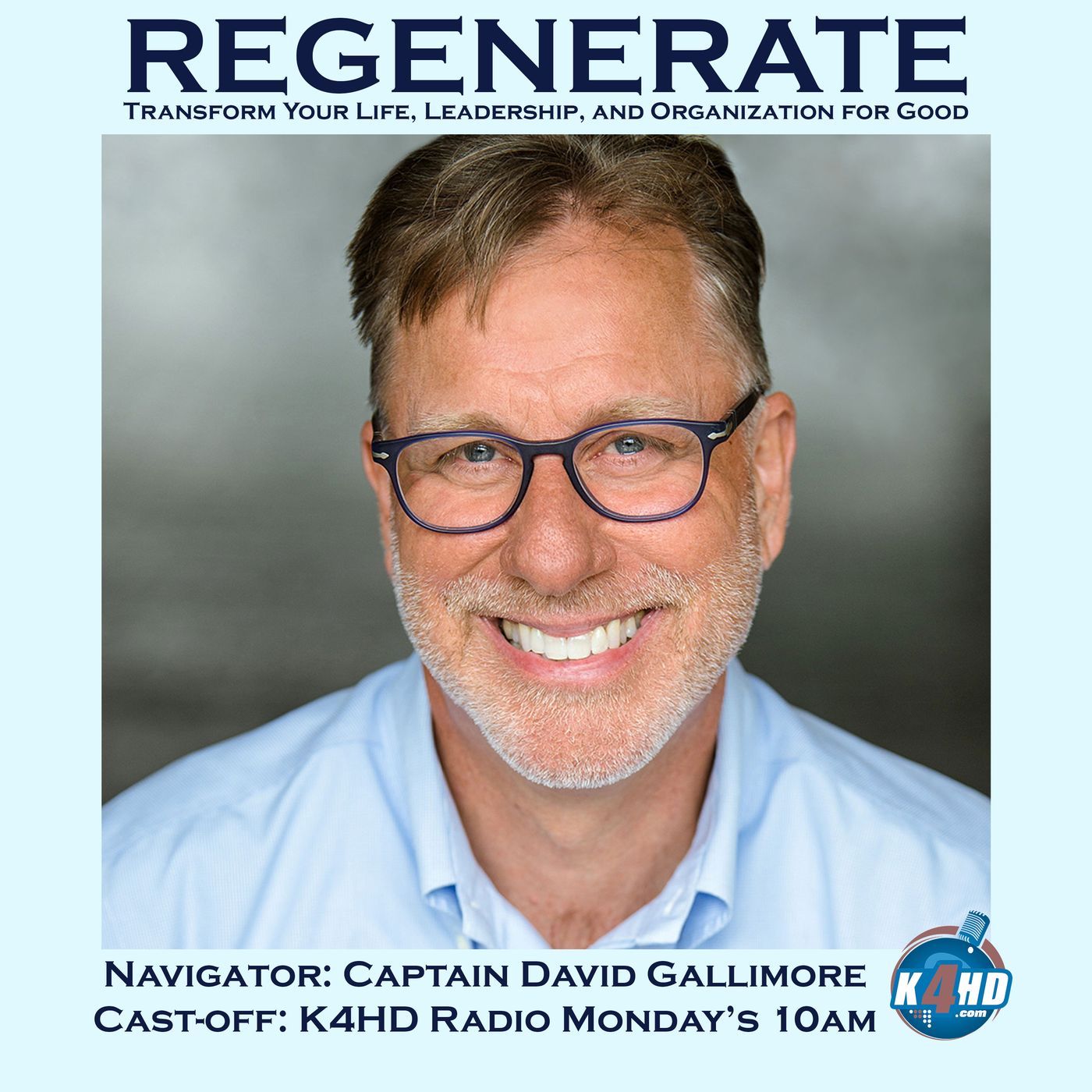
REGENERATE is broadcast live Mondays at 10AM PT on K4HD Radio - Hollywood Talk Radio (www.k4hd.com) part of Talk 4 Radio (www.talk4radio.com) on the Talk 4 Media Network (www.talk4media.com). REGENERATE TV Show is viewed on Talk 4 TV (www.talk4tv.com).
REGENERATE Podcast is also available on Talk 4 Media (www.talk4media.com), Talk 4 Podcasting (www.talk4podcasting.com), iHeartRadio, Amazon Music, Pandora, Spotify, Audible, and over 100 other podcast outlets.
Become a supporter of this podcast: https://www.spreaker.com/podcast/regenerate--6862974/support.
0:05 Ahoy! Captain David Gallimore welcomes you aboard the Regenerate Show, live Mondays, 10 a.m. Pacific on K4HD Radio at K4HD. com. Now, here's your host, Captain Dave, your personal regenerator. All aboard! Ahoy! And welcome to the Regenerate Show. I'm Captain Dave, your personal regenerator. So this show is really all about being a safe harbor for real stories about the messy middle, a part of the transformation of people and organizations that nobody posts about. And given all the economic pressures and global uncertainty and generative AI reshaping the ground literally under our feet, you're not sailing this voyage alone. But regeneration, which is the basis of our show, draws on 3.8 billion years of life's own logic, restoring vitality across every living system we inhabit and touch, from ourselves, our families, our teams, our organizations and communities, and ultimately our planet.
1:12 So together, we transform beyond merely sustainable lifestyles doing no harm and become like a healthy forest, endlessly regenerating resilient, abundant conditions for all life today and across all generations into the future to flourish. So whether you're a longtime crew or joining for the first time, welcome aboard. And here's my promise. First, we're going to have some fun. When we're laughing, we're learning. Number two, hope to leave you inspired. And finally, number three, leave you with just one takeaway that you can apply before you sleep tonight. So grab a pen. Transformations happen here. So as I look back on the last 32 Regenerate episodes, I see now that there's been a story arc. Back in February, we started with the individual. So episodes with Mathieu Graham around identity and specifically how I needed to rewire my own identity from being a corporate executive program manager to being a solopreneur and a media host. We transitioned from Mathieu to Bert Eckert, where he and I talked about emotional management and how the fears, uncertainty, and doubts that I've personally experienced that he's experienced, and perhaps you as well have experienced, how do we manage our emotions a little bit better? And other guests like Catherine Baker, who walked me through her Gales process, all about the gremlins,
2:45 the assumptions, the strategies that may no longer be serving us. And we then shift from individual to family. And you've heard me speak quite a bit about my loving wife, Margaret, of 35 years of marriage, and my kids, Ian and Catherine, who are adults and flourishing in their own lives, finding their way forward through the messy middle, and how important family has been to regenerating me and how I've been regenerating my family. And most recently, I talked about how that fire that happened just about a mile and a half to the southwest of our cottage at Lake Cushman, really tested our family and certainly gave me a lot more to reflect on as a result of how does nature look at fire and how can fire be a catalyst for improving our own lives. I've had a number of episodes related to teams, talking to Marcus Bauer and how he's leveraged a fabulous software tool called Goalscape to help him not only with his Olympic sailing successes, but now as an entrepreneur helping literally thousands and thousands of organizations around the globe organize themselves around a visual metaphor of a target and being able to change the pie slices of that target such that we can all stay
4:15 more focused on what really matters. And so today I'm now pivoting to organizations and specifically business organizations. So our theme today is purpose at the center and how one particular business that I have grown to really admire, I've become a customer of theirs, and I want to tell their story the best that I can, and that's Patagonia, and how they're in the process of becoming. They're not there yet. I don't think anybody arrives at becoming a regenerative business, but I think they're well on their way. They've certainly shown a lot of commitment and evidence that They can run a large organization profitably. And I'll be drawing from those experiences in my own business, Regenerative World Group, in the coming episodes. I think this is going to be a bit of a three or four part series, starting with Patagonia, then moving to Interface, the commercial carpet square manufacturer that Ray Anderson called himself a polluter, and how they transitioned to becoming not only sustainable, but now on the path, also becoming a regenerative business. And there'll be other organizations, both profit and nonprofit, talking to different guests about regenerative business in the coming weeks. So what if a company's only shareholder were the earth itself? In 2022, the founder of Patagonia, Yvon Chouinard, made that real. And he's kept running and growing a profitable business that tells
5:48 us to buy less. There's a fascinating story that I'll share in a few moments. So as I mentioned today on my own guest, we're sailing into a question every purpose-driven leader eventually faces. How can a business grow profitably and be a force for good, especially good for people, planet, and profits all at the same time? So we're going to unpack the differences between regenerative and sustainable and degenerative leadership and business practice and what profit is actually for, in my opinion. and why so many of us, especially me, haven't figured it all out. So I promise I'll share at least one regenerative leadership and business practice that you'll definitely want to apply later today. So since I'm my own guest, I'd like to share a bit about myself, especially as it relates to regeneration and regenerative business. And I want to make explicit my biases, because we all have them. Biases are what help us make sense of our world. Sometimes they can be very blinding blind spots.
6:54 And sometimes they can also just be a lens upon which I personally can ask Claude or Gemini or some of the favorite generative AI platforms that you may be using. I ask Claude to check for biases. So I've trained Claude on my biases so that I'm much more self-aware before I make important decisions. That's an action that you may consider if you haven't test-driven applied critical thinking. We had our guest Bryce Hoffman on about a month ago. He's the gentleman that wrote the book Red Team Thinking.
7:35 He's the only non-military leader who went through their military leadership around red team thinking, applied critical thinking. So check out that episode and we'll put that in the show notes as well. So what do I have to say about this transition from business as a profit motive machine to business as a more regenerative and role model for improving the health of our people and our planet. So for 30 years, I was proving that business can deliver profit and a lot of profit. So I built ventures and led teams inside IBM and Boeing and Capgemini, as well as T-Mobile. And over those years, eight different ventures, entrepreneurial ventures, so entrepreneurship inside large organizations. I had the privilege, my teams and I, of generating about $ 9 billion. And I'm most proud to say that every one of those organizations that I had the opportunity to co-found and build are still in existence. So I've learned through founding companies, as well as turning around companies, high-adrenaline, high-risk programs that people-first leadership isn't a soft skill. It's truly what makes the hard numbers possible. So I've already walked through this door from more profit-making to regenerative business when I left
9:07 Boeing in 2004. When that company lost its way, McKinsey brought in shareholder value, and that was really all about What are the practices and the measurements that cause a company to maximize profit and therefore stock price? And I could see the handwriting on the wall back in 2004 when then CEO Phil Condit left the company and Harry Stonecipher, who had been the CEO of McDonnell Douglas, he came back as CEO of the Boeing company. And he had a lot of stock shares with Boeing. And I was turning around a corporate venturing group with a number of other directors. We'd gone from zero net present value to $ 265 million in net present value, well on our way to a return on investment of a billion dollars on the initial $ 200 million investment. It was a dark, dark time when Mr. Sonsleifer pulled out his virtual gun and shot my team. After finding them all work, I left Boeing And frankly, I could have predicted a lot of what transpired with Boeing. It's thankfully they're working their way out of some of their cultural challenges and their return to quality and integrity and people first values. But back in the day, they'd kind of lost their way and they let profit drive so much of the behavior of
10:40 the organization to the point where things like MCAS and delays with the 787 program due to quality and planes falling out of the sky that never should have fallen out of the sky. So that's a cautionary tale that when an organization, when a team focuses on profit for its own sake, there's some potentially significant downstream effects from that. I had the privilege of founding our country's first business and law clinic at Seattle University, teaching how business and law students could help real-life clients, typically women on welfare, get off of welfare by lifting them up with a hand up instead of a handout. And that program is still in place after about 21 years. And what a privilege to serve over 600 students and clients in the seven years that I was the business adjunct. But it was really in November of 2021, OP26 in Glasgow, Scotland, where I had my spear in the chest moment You're going to hear about Ray Anderson's spear in the chest moment, the founder and CEO of Interface Inc., the industrial carpet tile company. But I was leading a team of about 35 folks on an AI project, how to sell more insurance, home insurance, something that I wasn't passionate about, but as the sole provider, it put food on the table. And
12:12 I came to a hard conclusion at that time of, all 8 billion of us stop burning fossil fuels tomorrow, the momentum already in the atmosphere would keep warming the planet. And so do no harm, sustainability was no longer enough. And so in January of 2022, I left my corporate job and founded Regenerative World Group. It's not been for the faint of heart. You've heard me share those stories, but I'm here to tell you that I believe that business can be a force for good. My thesis is, It's one of the biggest levers that we have. Politicians often respond to business leaders because business leaders or their organizations fund their political campaigns. And we know that products and services that are available to you and I globally are often created and delivered by businesses. My belief is, this is my bias, is that businesses, especially the largest organizations that are publicly held and report quarterly earnings and quarterly financial numbers, there's a huge bias within those organizations to do whatever it takes to maximize quarterly profit. And frankly, I'm part of the challenge because as an investor in public companies, I want the best return on investment that I can find. And Margaret and I have actually done a lot with aligning our stock portfolio, our investment portfolio,
13:44 to our values. And we gave up a lot of money in terms of return on equity, return on our market investments, because we decided not to go with oil companies or other organizations that are, in my opinion, are part of the challenge and creating a less healthy environment for people and animals and insects and the planet. Today, I believe profit is treated as the purpose with people and planet getting the bill now. And we know that quarterly targets are really short-termism, right? And the books count people as costs, never as assets, which is why we're seeing so much of a shift in replacing people with generative AI. And that can only accelerate. And my prediction is that there's going to be a lot of work upheaval and and we need work people need work for meaning and to feel a sense of purpose so when that work goes away i i worry about how people are actually going to feel happy about their lives if they don't have something that they can go to and and contribute with other people so that's a an episode for a future day but i think that's a real risk that certainly politicians and community leaders and organizations themselves are going to need to really lean in. Otherwise, if
15:15 we just let the tech bros keep doing what they're doing, I worry about the future of our work lives and what that will mean to self-esteem, what that will mean to providing for our families, which, you know, most people are not going to be independently wealthy. And I've not heard anything substantive about universal income. So, And by to be amazed. So the thing that I realize is that regeneration, it draws on the 3.8 billion years of life's own logic, where the goal is to leave every living system you inhabit or touch more alive than you found it. And so I've had the privilege of working with purpose-driven leaders since 2022, typically $ 5 to $ 50 million. And I get to start with the leadership and what are their core values, their ikigai, their reason for being what's their brand persona what's their strategy and then helping them execute and scale their organization relative to their purpose and their values and i've served over 105 clients since january of 2022 so that's a little bit about me and now what i'd like to do is is talk about eve chenard and agonia so it was founded by eve who was a climber in ventura California, 1973. And in the early 70s, Chouinard stopped making steel pitons. So these are the gadgets
16:49 that you would bang with a little mallet into the crack of a mountain earring adventure path. You've probably seen El Capitan and other really amazing climbs that mountaineers have been able to ascend. And they have a line that they're tied to And they have these various connections up the face of these rock walls. And it was a bestseller. But he realized very early on that if more and more people were using his steel pitons, they were actually causing the cracks in the rock face to widen. And if enough people were using those pitons, it was going to cause damage. the rock to deteriorate and perhaps make it really unsafe. And certainly it would damage the rock face and leave it scarred because of human activity. So he didn't want to do that. And he pushed for the idea of clean climbing and created this gadget that allows the piton to be inserted by a removable device that then has a soft piton connected to that kind of like a little gate. And when there's pressure on that gate, it protects and allows the climber to continue
18:20 to ascend. And if they lose their footing or their handhold, the rope will belay them and they won't fall and get injured or die. So he chose values over revenue, even though those steel pitons were a bestseller and making a substantial amount of money for the company. And he didn't call it regenerative, but he knew it was the right thing to do. So what really lights Patagonia up? Well, anything having to do with the outdoors, including climbing, surfing, sailing, certainly hiking and walking in nature. And they've built their workplace around what lights them up, including on-site childcare since 1983.
19:04 So a very, very early pioneer and kind of a mantra, at least in California, let my people go surfing. So this notion that it's not all about work, work, work, generate profit, increase stock price, but really trying to find a balance of people first, love them up. And guess what? The numbers, the financial numbers will come. Eve did a lot of bold moves. So including adding 1% for the planet, which is an organization that I support. They've been giving since 1985, and they've co-founded other organizations related to this. In 2011, during a Black Friday commercial, they said to shoppers, don't buy this jacket, which is kind of an anti-Black Friday message. But their thinking was, hey, do you really need to buy anything? And we'd love to sell you this jacket, but unless you really need it, don't buy this jacket. And then in 2022, they made Earth, their only shareholder. Now think about that. Yes, they have private investors, they have public investors, but their main shareholder is planet Earth, and they put money behind that. So they put 2% of their voting stock to the Patagonia Purpose Trust, and 98% of the non-voting stock to the Hold Fast Collective to protect nature. And since 2022, they've donated $ 180 million
20:37 to that Holdfast collective. Now, they're not perfect, but they're doing some things really well. In fiscal year ending 2025, they had $ 1. 47 billion in sales. And again, they're not perfect, but they're trying to figure this out. Their carbon emissions did rise by 2%, and only 6% of synthetic fabrics came from waste products like recyclables against a 50% goal. And in 2024, they had about 90 remote customer service staff let go after declining to relocate. I suspect as a result of the changes that people were making during COVID and many were leaving expensive cities, finding less expensive housing in more rural areas. But many organizations have realized that they're better together. They're better when people are face to face. And so That was a tricky thing to maneuver.
21:37 But they did provide 22 weeks of severance and a year of health care, which, boy, I wish I'd had that in the handful of layoffs that I've been a part of, that I've been impacted by. So in Chouinard's own words, Patagonia is not perfect by any means. We do not have all the answers. So why do I like Patagonia so much? Well, I've been hearing these stories over the years from more evolved people than I And I finally, when I was looking to buy a backpack for sailing, I wanted to have purpose-built backpack that would give me lots of different places to put the key things that I needed as a sailing instructor. And I looked and I looked all over and finally found one that I really liked and guess who manufactured it? Patagonia.
22:27 So I purchased the backpack. Now it was probably 25% more expensive. Then the next backpacks that I looked at, I paid, I think, $ 170 back in 2024. But one of the reasons why I bought the backpack, A, it fit all of my requirements, which were pretty extensive. I needed big space to hold books and navigation equipment. I needed little side pockets for my water bottle and other things that I was carrying around. And then little side pockets and top pockets. It really met my needs. But I noticed immediately when I received the bag, I purchased it online and it came in the mail, just the quality of it. And they had a little card that said, hey, if this needs any repairs, send it to this location.
23:27 And I thought, wow, that reminds me of my Allen Edwards shoes that I bought when I was in the corporate world. And when I wore the soles out, I would just send them back and they would resole them at a price. And I know Patagonia is going to also, there's going to be a price to repairing that bag. But that really, in this day and age, with fast fashion and just all of the tendencies to buy relatively inexpensive products that have planned obsolescence, For example, we just bought a whirlpool washer and dryer for the cottage. And the last washer and dryer we bought was still going after about 15 years. My mom and dad had a washer and dryer that lasted 35 years. The stated length of quality and life for this whirlpool was seven years.
24:24 So it'll be interesting to see if we get that or if it will die earlier than that. So this idea of planned obsolescence and how do you, as a consumer, make better choices for the long term, buy once, buy well, take care of it. And so that's really what won me over as well to Patagonia, their commitment to, I think, pretty much everything that you can buy from them if you want it repaired. Things like backpacks, duffel bags, jackets, all sorts of other gear. You send it back and they'll replace it or they'll repair it. So that that's worth a lot to me because I don't want to put stuff in the landfill that I don't, that I don't need to put in a landfill. So this idea also as a Scottish stretch of penny, uh, born and raised, I find that I spend way less money when I buy once and buy well and keep it well. So I hope if you find what I've been sharing so far useful, consider joining the regenerate community on our sub stack, which is titled regeneration in real life, where we go quite a bit deeper on these subjects. So when we come back, we'll be talking about three anchor questions, including what difference is there between regenerative and sustainable and degenerative business practices. So look forward to seeing you soon after this brief commercial.
25:50 You're listening to Regenerate with Captain Dave, your personal regenerator on K4HD Radio. We'll be right back. Are you feeling overwhelmed are you ready to regenerate and live the life of your dreams Start the transformation now. Call Captain Dave at 253-237-2558. Stop overthinking. Again, call 253-237-2558 or go to regenerativeworldgroup.com to book a free, no obligation clarity call. Let's get back to regenerate right here on K4HD Radio for more life-changing transformations. Here's your host, Captain Dave, your personal regenerator.
26:47 Ahoy, and welcome back. So if you're just now joining us, I've been sharing a few stories about my arc from being a corporate program manager to being a regenerative life leadership and business coach. And Our theme today is purpose at the center, how Patagonia is becoming, they're not there yet, but they're on the path to becoming a regenerative business. And what does that really mean? Uh, I shared a little bit about my background and why I was attracted to Patagonia. And then when I bought my first product, a backpack, how pleased I've been with the product and my purchases going forward as things wear out and are not replaceable or repairable, um, I'm committed now to the Patagonia brand because of Yves Chouinard, the founder, and what he stands for, their business practices, their commitment to fair trade and livable wages, and their commitment to really understanding their supply chain and trying to make the right decisions as a business to move forward with balance of profit as well as people first, plan it, and the health of our communities. So this next section, I'm going to talk about three anchor questions. And the first is, what's the difference between a degenerative, a sustainable, and a regenerative business?
28:15 So to answer those questions, I think it's helpful to just reconnect with three states of living systems. So a degenerative system is one that's in decline. It's getting worse. It's definitely not sustainable. Whereas a sustainable living system, by definition, it's maintaining the current state. It's the same. It's do no harm. But it's kind of, in the world of improving things, the floor, certainly not the goal, not the ceiling. Whereas a regenerative living system, think of a forest where there's birth and growth and decline and then eventually death.
28:58 That death feeds the nutrients for the next generation. early life, the new sprouts that are coming forth from the soil. So it's more alive, it's thriving, it's flourishing. There is death, there is decline, but it's in a cycle that allows us in the natural world to continue to grow and be stable. It's a closed loop system. You don't see forests necessarily expanding over time. They grow, and they stabilize, and then they keep that forest relatively intact until we human beings do other things to the forest and a forest can change across each of the four seasons from winter to spring to summer to fall and those four seasons are all vital so think of regeneration in business think of regeneration in your life as different seasons of And how do we manage through those seasons? But what's the difference between restoration and regeneration? Well, restoration by my definition is about repair or replacement of parts. So the old thing can work again, which is different than regeneration.
30:16 Kind of how the living body, our human body works. It keeps functioning. It continuously repairs, grows, The cells do die, but there's other cells that are replacing them. And so the human body revitalizes and renews many of its parts as some of the whole of the human body. Now, there's a myth, as I was researching this episode, that every cell in the body at some time or another is replaced every seven years. That's not true. So the accurate version is that the body replaces about 330 billion cells every day. Seems like a lot, doesn't it? And this comes from Sender and Milo from the Weizmann Institute, Nature Medicine. It's, however, mostly blood and gut cells, while our brain and heart muscle cells stay with us for life.
31:12 So that makes the metaphor even stronger, that the whole renews while some elders, elder cells, endure, like that old growth tree in a dynamic forest. Turns out the old growth tree is able to provide a lot of communication through the fungi. There's a whole communication and nutrition network below ground. And when that tree, that old growth tree, eventually exceeds its ability to have water come up to the very tip top of the tree and It either gets toppled over by the wind or by disease. Just before that happens, it sends all remaining nutrition down its trunk into those systems, the network that's linked to all sorts of other trees in the forest. And it's kind of its last gift to that forest. I mean, that just blows my mind when I think about it. There's so much that we're not seeing about the life of the forest. I want to talk a little bit about kind of my bias that so much of regeneration, I believe, is like a tree growing with rings spreading out with each year, with the core being ourselves. And what are our core values? What is our ikigai? What is our brand?
32:39 How do we want to show up in the world, which is the definition of a brand? And when we choose to be our best selves, then we're much more likely to bring a better us to our families and friends. We're able to bring our best selves to our teams, and therefore our teams can bring their best selves to their organization. And when organizations work better together and individuals work better together, our community works better together. And then you know where this is going. If all of those things are improving a little bit day by day, just like a forest then maybe we will think a little bit more about the health of our planet, our only ship.
33:24 And despite what Elon Musk says about we're all heading to Mars sometime soon, I think that's very optimistic. And I think, why not take care of our ship? You know, I'm a maritime captain. And one of the most important things that a maritime captain does, especially out in the ocean, but anywhere really, is taking care of the vessel. If it springs a leak, you got to find out where that leak is and you've got to plug the leak. If the boat's on fire, you got to find out where the fire is and put it out. Otherwise, bad things can happen. So we're relatively in a closed system. You know, energy from the sun comes in, heat, light gets reflected, goes out, but everything else is shared. And the other thing I learned about trees, again, in preparation for this episode, is there was an experiment done, I want to say in the 1600s, where a gentleman, sorry, I'll have to put his name in the show notes. He, over five years, he tried to figure out where is the bulk of the mass for the tree that starts out as a seed and winds up five years later, you know, weighing, I think they said 70 kilos. So a fair amount of growth. I think it was a pine tree that grew in a closed environment. And they weighed the soil after that five years. It had only declined by a couple ounces. The water only has, you know, H2O,
34:58 so there's no carbon in there. And so it wasn't the water that was causing it to grow and retain mass. It was the CO2, the carbon in the atmosphere that was causing. Now, back in 1690-something, he. Called that a gas, didn't know what it was, couldn't say any more about it, but that was a pretty remarkable insight to have that early. Now we know that there's a whole photosynthesis process and trees are basically created in the carbon in the atmosphere. And of course, we're the ones, animals, the ones that are providing a lot of the CO2, as well as just the natural processes of the earth. volcanoes and other things, fires that are creating that CO2. But it's a closed system. And so we have to be mindful of how are we acting in respect to all these other parts of the system.
36:00 So then regenerative leadership I define as creating environments where all life can thrive, where leaders of purpose-driven organizations leave people and the organization and profit better off, and more sustainable. So I believe that profits are necessary, but they result from purpose and shared values and great products and services rather than being the purpose. And there's a lot of examples that I'll get into in addition to Patagonia and Interface, B Corps, and Conscious Capital organizations and other forums where great people are doing really wonderful work. They're delivering products and services that have a market need, and they're trying to act more responsibly to improve the health of people and communities and our planet. So the purpose is really that strong center, right? And from that center, the people and the planet and the profit can be supported. And I'm a great believer also that hierarchy moderated by a flat organization, more entrepreneurial or intrapreneurial, Those kinds of structures we'll talk about in the coming episodes. At one point, Chris Rue and I were talking about teal organizations. So we'll put that in the show notes as well. And ultimately, when we think about AI and how the designers of
37:30 generative AI could choose to use AI to augment people's strengths and not replace people, we might find that people are way more loyal and way more dedicated to their organizations because they know that there's going to be the chance to be upskilled. And rather than be replaced, they'll have an opportunity to do more dignified work, more interesting work. I mean, that's the future that I would like to build. And I invite any of you that are listening who have the chance to figure out how to apply a Claude and ChachiBT and Gemini and others to How do we do it to make our human-centric organizations more resilient, more productive, and not fall victim to the, well, let's just replace people with computer systems? Because is that the world that we really want to live in? And do we want to have the blood on our hands as leaders of having increased unemployment or great hardship for families just for profit's sake? So these are challenging questions, I know, but there are questions I think we need to be asking.
38:42 So can a regenerative business grow in today's capitalistic world and should it? So again, I have a bias, and that is that if I can help scale regenerative leaders and regenerative businesses to perhaps disrupt those organizations that don't want to help improve people health and planet health let's just call them polluters like ray anderson the ceo at interface called himself i'm a polluter i called myself a polluter after watching al gore's an inconvenient truth and it's what caused me to stop being a road warrior after nine years of flying sometimes two to four legs two to four flight legs a week or 50 we a year, I was a polluter. And once I woke up from that fact and with Margaret's support, I stopped traveling for work and was an early adopter of telecommunications-led meetings and leadership through Zoom and other tools. So I also recognize that we have to be practical. Until short-termism, quarterly profit pressures, and accounting, frankly, that counts people as costs and not as assets on the balance sheet, change is going to be really hard. And I get it. Purpose-driven leaders, purpose-driven founders, you got to play by today's rules. Otherwise, how are you going to attract capital to invest in people and
40:14 machines and innovation? So it's a balancing act. But I would suggest that using the forest, using the logic of life, organizations can enrich their purpose, can enrich their organization through purpose. And we know that growth for its own sake is not necessarily a sustainable thing. I want to highlight Kate Raworth's work, her Donut Economics, where she has identified these boundary layers. So imagine a donut. And the outer layer of the donut, the outer edge of that donut, is the planetary boundaries that have been either met or exceeded.
40:59 The sad thing is that seven of nine planetary boundaries have breached. And that'll be a subject, I think, for another episode as well, because that's a great way of visualizing kind of where we are and what we need to do to get more regenerative processes to renew ourselves. and heal, not sustain, but actually improve those planetary boundaries. And then the inner edge of the donut are the social areas, living wages, and all different types of people able to feel like they're contributing. So there's a diversity and inclusion. So those kinds of boundaries, what we're learning is on the path that we're at, that we're going down profit first, stakeholder, shareholder, whatever you want to call them, focusing on profit rather than on people and the health of our communities and our planet, it's, in my opinion, not going to be sustainable. And we're already seeing the cost of insurance rising. We're seeing the many businesses that are not able to support their profits because the next generation of consumers are much more purpose-driven and they're in spending their consumer money on the things that support their values.
42:21 So in closing, I believe if Yvon Chouinard were offering hard-won wisdom to you, our next generation leaders, I think he would share something like, and this is in his own words, Patagonia is not perfect by any means. We do not have all the answers, but we're committed to making decisions that move us forward aligned with our purpose. And From my heart to your heart, my belief is that regenerative leadership is a path forward. Thinking through the logic of life, how do you make things better than you found them? And I think that's a way to grow a business without losing its soul. So the key takeaway, grab your pen. Transformations happen here. Before your next big decision, consider writing down your team or your organization's purpose. at the top of a piece of paper or a digital journal, whatever you do to kind of write your thoughts down and ask, does the choice I'm about to make leave myself or my team or our organization or the community or the planet? Pick your level. Ideally, you're asking that of all of those levels. Does it leave those in a better place or does it make it worse? And I think If we make decisions day by day, week by week, month by month, and we use the logic
43:54 of life to make things better than we found them and not make them worse, but not through just one lens, that broader lens of purpose, people, planet, and profit, we will improve our lives and make this world a better place. So our next episode, episode 33, is going to be what gets measured gets done. How Interface is transforming from polluting manufacturer to profitable, regenerative business. If you receive value today, I ask you to subscribe. Forward this to someone who needs it. Leave a review. Your support really helps purpose-driven leaders come aboard and helps us create a healthier world faster.
44:36 Thank you for investing your valuable time on behalf of Rebel Meddler, our producer, and the entire Talk4Media team. Stay healthy. Stay safe. We need you. And we're certainly better together. Now, let's go regenerate. Thank you for listening to Regenerate with Captain Dave on K4HD Radio. We invite you to give yourself grace and embrace the messy middle. See you every Monday at 10 a.m. Pacific Time. Until then, you got this.


