
Learning from Fire: What Scorched Earth Teaches Us About Renewal through Regeneration

 iHeartRadio iHeartRadio
 Apple Podcasts Apple Podcasts
 Spotify Spotify
 Pandora Pandora
 Youtube Music Youtube Music
 Deezer Deezer
 Spreaker Spreaker
 Podcast Addict Podcast Addict
 Castbox Castbox
 PocketCasts PocketCasts
 Castamatic Castamatic
 Goodpods Goodpods
 Overcast Overcast
 Podurama Podurama
 Podverse Podverse
 YouTube YouTube iHeartRadio iHeartRadio Apple Podcasts Apple Podcasts Spotify Spotify Pandora Pandora Youtube Music Youtube Music Deezer Deezer Spreaker Spreaker Podcast Addict Podcast Addict Castbox Castbox PocketCasts PocketCasts Castamatic Castamatic Goodpods Goodpods Overcast Overcast Podurama Podurama Podverse Podverse YouTube YouTube
What if fire — the very force that threatens to take everything — is also nature's oldest teacher of renewal? After flames came within two miles of our family cottage, and a summer of fire scorched three continents, REGENERATE asks what scorched earth can teach us about coming back stronger — as people, as leaders, as a species buying time for life to adapt. If not now… when?
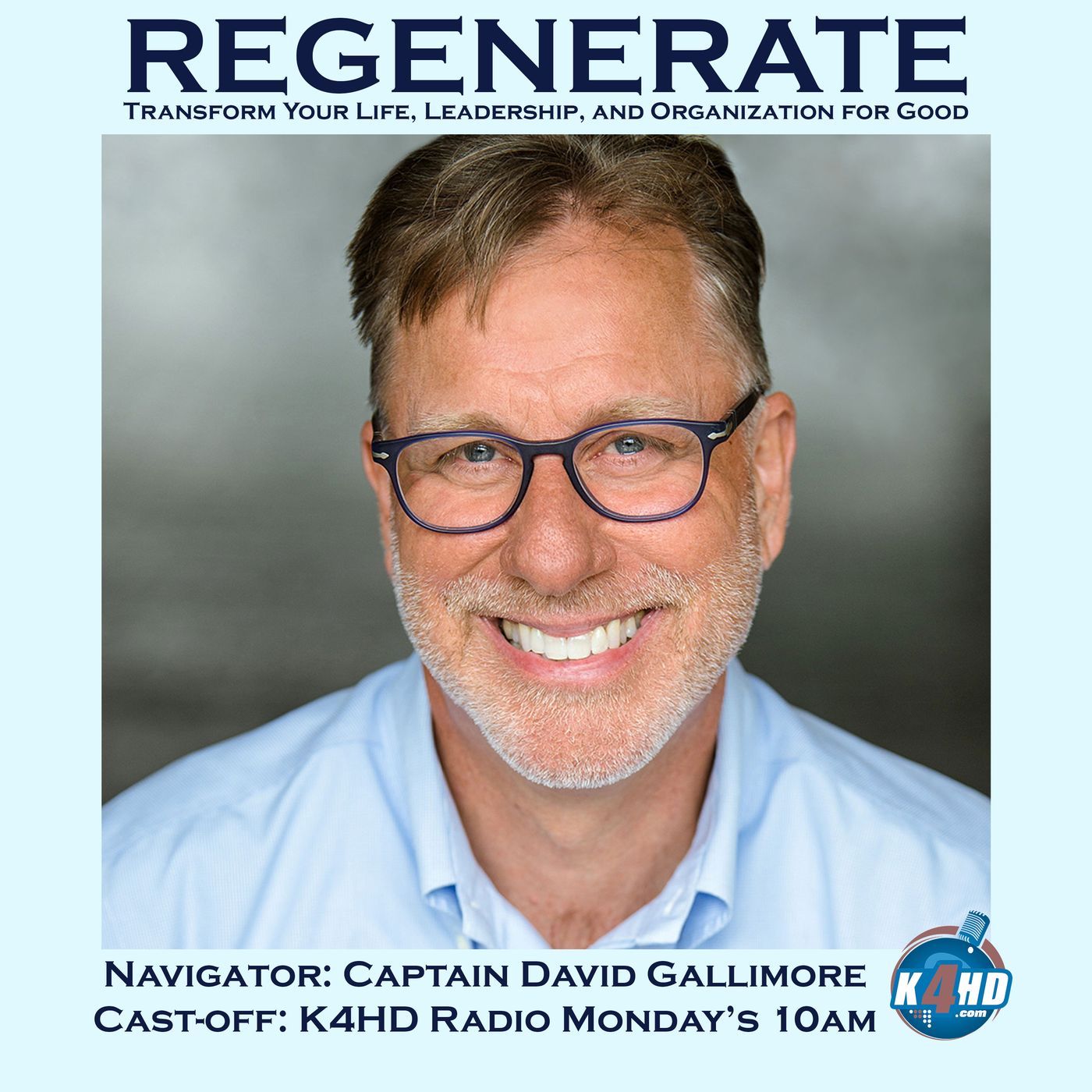
REGENERATE is broadcast live Mondays at 10AM PT on K4HD Radio - Hollywood Talk Radio (www.k4hd.com) part of Talk 4 Radio (www.talk4radio.com) on the Talk 4 Media Network (www.talk4media.com). REGENERATE TV Show is viewed on Talk 4 TV (www.talk4tv.com).
REGENERATE Podcast is also available on Talk 4 Media (www.talk4media.com), Talk 4 Podcasting (www.talk4podcasting.com), iHeartRadio, Amazon Music, Pandora, Spotify, Audible, and over 100 other podcast outlets.
Become a supporter of this podcast: https://www.spreaker.com/podcast/regenerate--6862974/support.
0:19 Ahoy! Captain David Gallimore welcomes you aboard the Regenerate Show, live Mondays, 10 a.m. Pacific on K4HD Radio at K4HD. com. Now, here's your host, Captain Dave, your personal regenerator. All aboard! Ahoy, friends, and welcome to Episode 30 of the Regenerate Show. I'm Captain Dave, your personal regenerator. So this show is all about being a safe space for our guests. And today I'm going to be my own guest and I'm intending to be as vulnerable, true, not performative in the stories that I share about the messy middle of my own personal professional transformation. I'm not going to be focusing on organization today, but more personal and community. These are stories we need now more than ever to inspire us to grow into our better selves, to improve our health and to become more resilient, to better handle all sorts of disruption from AI to climate change, to economic and political uncertainty. So I point to hope today to provide a few simple strategies and tools that you can use to become someone who brings more resilience, purpose, authentic energy to the people that you love. And when you're ready, to our planet, our only ship. So what is regeneration? Well, my belief, it's the underlying nature-based framework of the show,
1:51 and it draws from 4.5 billion years of life. And I learned to change that number from 3.8 billion after one of our guests, Jovan Barnovic, who we had on last week. And that's when the earth really became this ball But it was the vessel upon which life emerged. So I'm changing my, I can, I can be taught this old dog can learn new tricks. And so regeneration really draws from that original four and a half billion years when the planet was really formed. It's about restoring vitality across every living system, ourselves, our families, our teams.
2:34 And what I want to talk a bit about is our communities today and working together. I believe we can move beyond mere sustainable living and In other words, do no harm to regenerative living, becoming like a healthy forest, nurturing across the seasons, a resilient and abundant life. Not just plants, but animals and probably human beings have lived in the forests. So regeneration shows up in many forms. For example, today I was on a call with my dear friend and colleague, Bert Eckert from Belgium. For those of you that are just now joining the Regenerate show, he was our second guest. back in February, and he's an expert in emotional management. But sometimes even experts need someone to simply listen and let them know they're seen, heard, and loved for who they are. Well, that's the work that I got to do today. So I created Regenerate, this show to lift up purpose-driven leaders, to connect them in bonds of love and adventure, creating, building leadership and impact.
3:38 As a guide, a maritime captain, and a lifelong learner, I really feel the privilege that I get to live my ikigai, my reason for being, every day. So whether you're a longtime crew or joining for the first voyage, welcome aboard. I hope you discover something today that changes how you see yourself, and especially what's possible to improve the health of our people, especially our communities, our planet, and I think profit as well. And some of my friends that are in the environmental world world, they don't like it when I talk about profit, but profit allows us to fund the investments that are going to be required to be able to become more in harmony with our planet. So consider it your role model. And if you like this content, share it with others and be a teacher of regenerative living. So finally, here's my promise. First, we're going to have some fun today. Second, I hope to leave you inspired. And third, leave you with just one thing you can apply before you sleep tonight. So please grab a pen, digital or real, and transformations happen here.
4:45 So our theme today is learning from fire. What scorched earth teaches us about renewal through regeneration? So learning from fire. But I want to start with a story. So last year, July 4th weekend, there were a number of young people at Lake Cushman, where we now call home, and they were having a great time at a place called Party Rock. And every July 4th, people bring fireworks into the national forest. So we're in the Olympics, and it's illegal to fire fireworks in a national forest for kind of obvious reasons.
5:28 It's often filled with flammable fuels, everything from grasses and and bushes all the way up to trees that are 20 to 25 feet in diameter. I mean, old growth, Douglas firs and cedar, they're, they're just majestic. But in July in the Seattle area, they're the driest they'll ever be. Maybe not quite as dry as they'll be in August, but certainly very dry. And so it's just a tender or a problem to happen. Last July, some kids were shooting off fireworks. And one of the bottle rockets landed on a very dry part of a very steep slope.
6:16 Mount Rose is the mountain. And within minutes, that fire was raging. It took a few hours, but it climbed very quickly and very broadly up to the top of Mount Rose. And almost 10 years later, you know, just slightly shy of 10 years. So the previous July 4th of 2016 was when we had a similar incident where young people were firing off fireworks and that triggered Bear Gulch Fire number one. And so nearly 10 years later, there was Bear Gulch Fire number two. And our cottage is only about a mile and a half away. Now, thankfully, our son, Ian, excuse me, Gets me all choked up just talking about it. Our son Ian and his two dogs were here at the cottage at the time. And so they were able to be a scout for what was going to unfold over the course of several months.
7:19 In hindsight, he put himself at risk. We had several discussions about the air quality because a fire that big, it actually grew to 22,000 acres. So it was almost three times bigger than the 2016 Bear Gulch fire. And because of the prevailing winds from the Southwest and the fire was Southwest of us, a lot of that smoke came into Lake Cushman developments and into our cottage. He's a smart man. And so he stayed indoors and he had these HEPA filters. So he was able to, maintain a reasonable air quality inside the house, inside the cottage.
8:07 But it was absolutely frightening because when you think about it, if the prevailing winds were doing what they often will do in the wintertime, which is to come rise at some 15, 20 miles an hour, gust to 25 miles an hour, it doesn't take very long to cover that mile and a half with a fire. And it's the embers, apparently, as we've been learning over the years, that is the biggest risk. So when the wind was blowing the smoke away from our cottage, Ian was up on the roof and installing different protective measures under the soffits and in the venting and in our fireplace. And he had a go bag. He was ready in case the authorities requested that people leave. On the other side of Lake Cushman, the residents were mandated to leave and sadly many lost their homes or their structures that they had on the other side of the lake. I would say that through the ordeal, the Forest Service and I would say it's the Department of the Interior, they really responded quickly. We had probably more than our fair share of firefighters and airplanes that were swooping down and picking up water and then taking off again and dropping that water on the fire.
9:37 And they ran sortie after sortie after sortie for weeks. So I felt a lot safer. My son felt a lot safer because of all of the attention that this particular fire was getting. In the 10-year-old version of it, Bear Gulch Fire 1, the authorities had way higher by a And so ours kept raging. But apparently it was just naturally more contained. Not sure why. And it was not until that following fall, winter. So that fire went the whole winter before it was really put out. Whereas this fire, the 2025 fire, it was largely contained before the winter snows. The rainy season certainly helped in October and November. And then when the snows came in December, that's what put the fire out. And my hat's off to the amazing people, firefighters on the ground, the community that came together. it was really a remarkable outpouring of how a community can work together when their collective backs are against the wall. That gives me hope for the future in terms of how the community came together. And my own son, Ian, I'm so proud of him. He did a lot to meet the firefighters with water and food.
11:08 He bought dozens of different foods for them and Many of them wanted to have some chewing tobacco, so he would buy that. Whatever the firefighters needed, he was there for them. I just love that about my son. He's got a huge heart, but he does something. He makes things happen. And on Facebook, boy, I'll tell you, the outpouring of love and support was pretty remarkable. I don't think I saw any negatives. trolling or any negative comments to what was happening. So it was really a great moment, I think, for our community that really did come together.
11:49 And like I mentioned just a moment ago, it gives me hope that maybe we can work better together when we have a common enemy. Can I call it that? Certainly fire is one of the scariest things. And you're basically only about six minutes away from in a mile and a half, given how, how the embers can really fly at, at just at the roof, at just at the treetops. And that's what catches a fire. So it's, it's just an amazing experience. Now, obviously there's a lot of ramifications to our community about how do we keep the environment safe? I can only imagine how much wildlife was lost. You know, mammals and, Insects and, of course, all of the trees and shrubbery, grasses and things, and the streams that have been polluted from all of that.
12:51 And then not to mention all of the carbon that was emitted into the atmosphere. That's going to be adding to our carbon footprint up in the atmosphere. That's only going to cause even more, in my opinion, in the consensus of science around the globe, CO2 and methane are two of the gases that are contributing significantly to our rising average global temperatures. And we'll put in the show notes some of the references to that. So part of what I wanted to share next, when we go to our, after we come back from our commercial break, I want to talk a little bit about, you know, what are the lessons from Bayer? How does a scorched earth teach us about renewal through regeneration? Rebel, if you'd be so kind to just roll the commercial and then we'll be right back.
13:46 You're listening to Regenerate with Captain Dave, your personal regenerator on K4HD Radio. We'll be right back. Are you feeling overwhelmed? Are you ready to regenerate and live the life of your dreams? Start the transformation now. Call Captain Dave at 253-237-2558. Stop overthinking. Again, call 253-237-2558 or. Go to regenerativeworldgroup.com to book a free, no obligation clarity call.
14:31 Let's get back to regenerate right here on K4HD Radio for more life-changing transformations. Here's your host, Captain Dave, your personal regenerator. Welcome back, friends. So if you're just now joining us, I'm my own guest today. Brilliant, of course. And I'm talking a little bit about now how fire and all of the ramifications of fire, what scorched earth, can teach us about renewal through generation. And I shared a short story, or maybe not so short, of the Bear Gulch fire at Lake Cushman in the summer into the fall and winter of last year, 2025, and how devastating it was and how scary it was, but how the community rallied and we came together and a lot of resources to the credit of the Interior Department and the local and regional and state firefighting community. They brought their A game, and I'm so grateful. So I did say before the break that we were going to go into some of the regenerative lessons learned, but I forgot that I wanted to talk briefly about this year's challenges with fire. So this summer, fire went planetary. For example, over 267,000 people were evacuated from Spain and France in a matter of days.
16:02 And First Nations communities had to be airlifted out of northwestern Ontario by the Canadian Armed Forces. And firefighters from Mexico, Costa Rica, New Zealand, Australia came across oceans to help because no country has enough crews alone. And so when it's the winter down under in the southern part of our planet, they have firefighting resources that are now freed up. And so thankfully they were willing to come and help us. And I think the reverse will likely be happening in our winter when the fire season is far less and we can send our resources to help fight fire in New Zealand, Australia, and other parts of the world. So smoke is this great equalizer. 345 million people were exposed to unhealthy air this summer versus a comparable 2023 season.
17:01 There were over 70,400 deaths reaching people who never saw a flame. And that, perhaps, was the biggest awakening that I had during our 2025 fire. It's the smoke that can kill, not just the flames and the heat. And of course, there must have been millions of animals that lost their lives, an unknown number. And we often don't get to grieve those losses because we don't see those animals, those insects. So not everything is a record, but it's volatility and it's a rising baseline, longer, fiercer fire seasons.
17:44 Communities that have never before evacuated are now doing so routinely. And so it's my prediction, And I hate to be the Dave Downer about this, but I do believe that this is going to be more of our future. And so we can either be Pollyanna about it and not be aware of all of the real risks. We can just own and keep living lives. But fire doesn't care if you're beautiful or ugly, if you're wealthy or poor, if you're stupid or ignorant or just, want to be an ostrich and put your head in the sand, it'll kill you. So Mother Nature doesn't really have an emotion about this. We do when we get impacted by it.
18:32 But yeah, Mother Nature, she's going to do what she's going to do. And we can either be realists and then do something about what's likely going to be our future, or we're going to have a really, really hot and dangerous fire season. And it's going to be basically... 24-7 around the globe, because when it's our summer, the risks will be in the Northern Hemisphere. And when it's the Southern Hemisphere summer, the risks are going to be down under. So the question that I've been thinking about for this show is, what does fire teach us about renewal? Fire exists in nature before men and women figured out how to take a flint and a rock and create a spark.
19:22 or before we rub sticks together to create heat, which then turned into flames. So Mother Nature had invented fire, you know, hundreds of millions of years. Let's just say we were born from fire, the crucible, 4.5 billion years, according to Javan. So fire is just part of nature. So with renewal... what I understand after doing a little bit of research a few years ago is you've got trees that have serotonin cones. So the jack pine, the lodge pole, they only open and become what they were meant to become, a tree. inflames heat. So they actually are designed, they come to life only in fire. And the fire following after the devastation where plants and grasses and trees have been consumed by the fire, the first life that starts to emerge are wildflowers. Weeds, you might call them, but many in the forest are really beautiful wildflowers.
20:39 And they provide the beginning of that nutrient cycle. And because the tree canopy has been cleared, so that light now is available to those nascent plants. And so they thrive. And apparently the ash is a pretty good soil nutrition, soil nutrient. So the destruction and the renewal are part of the same event, but they're just on different timelines. We also know that, um, there have been peoples, the indigenous peoples from around the globe that really used fire effectively. I think good fire, if you want to call it that. So they did cultural burning, you know, tens of thousands of years of stewarding the land with fire rather than against it. Now they had that opportunity to use fire to, you know, clear the path, if you will, and regenerate with new life, new plants, new animals, because they were more nomadic and they could move away from the fire that they might have set purposely to clear the forest so that when they came back in a few years, it would be more plentiful with new life, new berries, new foods to be able to hunt and gather from.
22:02 So a century of us now, recently, sophisticated, developed world citizens where we have chosen to suppress fire for a lot of very good reasons, right? Many more rural communities now have homes and businesses and factories and solar farms. I suspect that there'll be data centers that are going to be built in places that are might not be the best places to build them, but the land is cheap and so they're going to build them. But the fuel load has been building in that century of allowing human beings to control the environment rather than letting the environment do what it has done for millennia. And so with all of that increase in fuels, we're basically feeding these megafires. And this is part of why I'm so attracted to regeneration is we human beings acting outside of nature, thinking that we can control nature. I think we're waking up to the fact that as much as we would like to control nature, nature is going to do what nature is going to do. And so it's a lesson of what happens when we serve ourselves and sever ourselves from nature's logic. And so what's fascinating to me, it takes a little bit of humility, but Primitive, when old
23:34 white guys like myself talk about, oh, how sophisticated I am, the sophisticated practice is really the one that's doing the harm. The primitive practice or the indigenous practice, I think that's more accurate, more respectful. The indigenous practice is much more aligned with nature's logic and not severed from other nurturers. So from forests to humans, this idea of regeneration, um, there's this pattern where nature runs after catastrophe and she doesn't rebuild the same. She rebuilds healthier and more diverse and therefore more resilient. Isn't that interesting? So I've seen this when our family has gone on hikes, um, not just after Barragulge fire number one, but also Barragulge fire number two, um, the forest is just alive with life and that's very exciting. And it's accelerated the death of the older growth that just was not serving the greater good in the forest. Now there's still a lot of old growth trees that have survived. Yay us. And that's nature, right?
24:51 Calling through the herd, if you will, or using evolution, um, those plants and animals that can adapt faster, they're going to thrive as a result of that catastrophe. So regeneration is not sustainability, right? Sustainability is holding steady. You sustain a note, that is not moving forward. Whereas a regenerative approach is leaving the system more alive than nature found it at the beginning. And so When you think about fires and how it relates to us as individuals, we have our identity, we have our view of the world, our roles, we hang on to these identities as certainties.
25:42 But sometimes the world is changing around us, isn't it? We know that from just picking up the news or watching social media. And just like the dinosaurs, died off because they were not able to adapt. My belief is that we human beings, should we choose not to adapt fast enough, there's no guarantee that we'll be on the planet. Mother Nature, again, this is the sixth life-changing epoch. There have been five previous epochs where about a third of life has been killed off. in ice ages or in fire so this is our sixth one of these and we know that we're in a receding ice age so that we know you know mother earth is just getting warmer based on her cycle as she's orbiting around our sun and and our sun is orbiting around other celestial bodies so it's kind of that perfect storm that seems to be happening at this time in our history on earth We've got Mother Earth getting warmer on her own.
26:53 And then we human beings, based on the science that I've read, and I do believe it, that we human beings have our finger on the scale and we're accelerating these changes. So we have an opportunity to look at our identities, look at our lifestyles and say, hmm, how's that going? How's that working out? And what do we need to burn? What do we need to shed? What do we need to allow to emerge? And that's really why I gave up the corporate crazy back in January of 2022. My identity, and Javan and I talked about this a little bit last week in our episode around regeneration and living your values, designing your life rather than life designing you, and And I told a story about how my identity was so tied to my income and my title and what company brand, you know, IBM or Boeing or Capgemini or T-Mobile. My identity was wrapped up in all of that. Certainly my identity was also greatly influenced by my family. I do everything because of wanting to serve and support my family. And thankfully, um, My wife feels the same, and so we've never been more aligned on how do we help ourselves and our children by strengthening and nurturing, regenerating, if you will, our family.
28:23 By the way, Margaret returned from several months up in Alaska supporting our daughter Catherine with her, Margaret's and my Granddaughter, Daisy, who's just a ball of fire, unintended, and helping our daughter, Catherine, prepare for the birth of our second grandchild, Calvin, who has 10 fingers and 10 toes, big old head of hair, and healthy lungs. So he's peeing and pooping and just what one-month-olds should be doing. So Margaret's returned, and I'm so grateful. If you're listening... Maggie, I'm so grateful, more than you even can know. Because when you are doing a lot of what your best friend and partner also does, everything from project work with us, my son and I, as well as shopping and cooking and cleaning, and she's an amazing chef, but she's also a creator. And it's been fun since she returned on Monday to see her regenerate her own spaces and create her own new habits and new rituals now that we're at this location rather than at our old home at Dashpoint. So I'm really, really grateful that our family is together and never been closer.
29:48 So I'm a bit of an optimist about this. I do think that regeneration in real life is a thing, but it's not a solo act. So If you think about the Spain and France and other parts of the globe, I think the Canadians, they had a very difficult time as well. You know, devastation, it crosses borders and so did the help. So resilience, you know, this is a regenerative truth. Resilience is really a shared capacity we build together person by person, like my son, who was helping the firefighters the best that he knew, meeting them where they were, the community that came together. And at the end of the day, we are better together. So I want to leave you with three things to think about that hopefully you're inspired from this conversation to maybe take a step or two. So the first thing is selfish, but I frame this in the light of putting my own mask on first. which is what you've probably been hearing whenever you get onto an airplane before it takes off.
30:58 They remind us to put an oxygen mask on first. Why? Because if there isn't any oxygen in the airplane and there's a crisis and you're trying to serve everybody else, it's not going to be a few more tenths of a second before you passed out and now you're no good to anybody, especially yourself. So building that resilience before the fire, build resilience before the fire. I think is hard. It's simple. It's a simple idea, but it's not easy. So what does that mean to build resilience before the fire? Well, it's really taking a hard look at our health. And are we doing the things day to day that are regenerating us, renewing us, recharging us, or are we on the work, work, work treadmill that so many Americans are on?
31:49 And in my conversation with Barrett, He was telling me that, yeah, in Europe, they have a very different view of vacation. It's not like a long weekend and then they're back to work, crazy, crazy hours. They'll take a month off. And he and his wife and family took six weeks off, which he said that was a little bit too long for him. I can appreciate that. But if you do get your vacation time and you don't take it because you're building it for some future need, The research is really clear that that's probably not serving your health. Secondly, building resilience is understanding what your why, what your purpose, your meaning in your life. And we've talked about this topic several times, starting with the first episode with Matthew Graham and rewiring identity, but having a clear why and purpose and meaning in rewiring my identity. And we've talked at length about purpose and why with core values. That was about four or five episodes ago. And then most recently, the ikigai, the reason for being. What are you gifted at?
33:05 What are you passionate about? What does the world need? And what can you be well compensated? And I include in that compensation freedom and inner peace and community, if those are values for you. as well as for me, not just money, not just medical insurance or bonuses or some of that financial wealth, but wealth in the broader sense of inner peace and freedom, which I think many of us are sorely lacking. I feel grateful that I have found that again. And I'm so grateful for my wife, Margaret, and our family supporting me in doing that. So another of these next actions that you could consider taking is within your family, your team at work, or if you're at a nonprofit or a team that you might be on, or like a sports team that you're on when you're not working, is this idea of regenerative leadership. So making decisions that leave people and place and profit, I think all three of those need to come together. And some even add purpose, a fourth circle in the Venn diagram that need to come together to create more thriving in those teams and organizations and to design the organization, the environment to be able to adapt going back to the dinosaurs.
34:37 One of the reasons that they perished is they were not able to adapt to the climate change after that huge meteor struck the planet and created basically almost an instantaneous winter. I don't know that anybody could have adapted to that. But this idea that if we don't kind of think about how might we adapt, like what Ian did with covering holes in our infrastructure at the cottage that would allow embers to come in, if we don't proactively adapt our environment, then we're really at the beck and call of those embers. Those embers are going to do what they're going to do. And if we haven't done anything to mitigate that risk, then they have reentry into all the little holes and crooks and crannies. And once those embers get inside your structure, there's a lot of flammable material, a lot of accelerant in our homes that then just cause them to burst into flames. So it's not just about efficiency. It's also about how do we adapt. And then finally, at a planet and community level, how could we provide mutual aid as a way of life.
35:49 So how many of you know your next door neighbors? I'm guilty of this as somebody who was a road warrior and working all the time. I didn't really nurture relationships with my next door neighbors. And yet, if you believe as I do now that we're better together in the event of, say, an earthquake in the Seattle area or a fire, God forbid, you know, who's got what resources? So many of our neighbors were grateful to know that we at 23,000 gallons in a pool, not for drinking water, but for other purposes that they might need. And certainly we could boil the pool water to create fresh water.
36:31 So knowing the local resources, knowing your environment, what's happening with the streams, the rivers, the lakes, and knowing the capabilities of each of our neighbors, ourselves as well, those small compounding acts that can buy time for us to adapt. So in closing, yes, fire is incredibly scary and it's devastating. And for those that have lost lives, their loved ones who have lost their favorite pets, their property, my heart goes out to you. And I feel like our family dodged a really big fiery bullet. So for next week, next show, We're going to be continuing to talk about regeneration.
37:18 And I can't wait to see you next Monday at 10 a.m. Pacific, 1 p.m. Eastern, 6 p.m. CET on k4hd. com or on your favorite podcast platforms just a few days later. So check out our website, theregeneratepodcast.com. Thank you for investing your valuable time. And on behalf of Rebel Medler, our producer, bless you, Rebel, again, And our Talk4Media team, stay healthy, stay safe. We need you. We're better together. Now let's go regenerate. Thank you for listening to Regenerate with Captain Dave on K4HD Radio. We invite you to give yourself grace and embrace the messy middle. See you every Monday at 10 a.m.
38:01 Pacific time. Until then, you got this. Thank you.


