
From Sunday Dread to Monday Purpose

 iHeartRadio iHeartRadio
 Apple Podcasts Apple Podcasts
 Spotify Spotify
 Pandora Pandora
 Youtube Music Youtube Music
 Deezer Deezer
 Spreaker Spreaker
 Podcast Addict Podcast Addict
 Castbox Castbox
 PocketCasts PocketCasts
 Castamatic Castamatic
 Goodpods Goodpods
 Overcast Overcast
 Podurama Podurama
 Podverse Podverse
 YouTube YouTube iHeartRadio iHeartRadio Apple Podcasts Apple Podcasts Spotify Spotify Pandora Pandora Youtube Music Youtube Music Deezer Deezer Spreaker Spreaker Podcast Addict Podcast Addict Castbox Castbox PocketCasts PocketCasts Castamatic Castamatic Goodpods Goodpods Overcast Overcast Podurama Podurama Podverse Podverse YouTube YouTube
You've built real success — yet Sunday nights still carry a quiet dread. What if Monday became the day you couldn't wait for? Drawing from his Regenerate YOU! playbook, Capt. David walks you through the four circles of Ikigai — what you love, what you're great at, what the world needs, and what you can be paid for — and the daily practice that turns dread into direction. Purpose isn't a destination you arrive at. It's an adventure you live into, one day at a time.
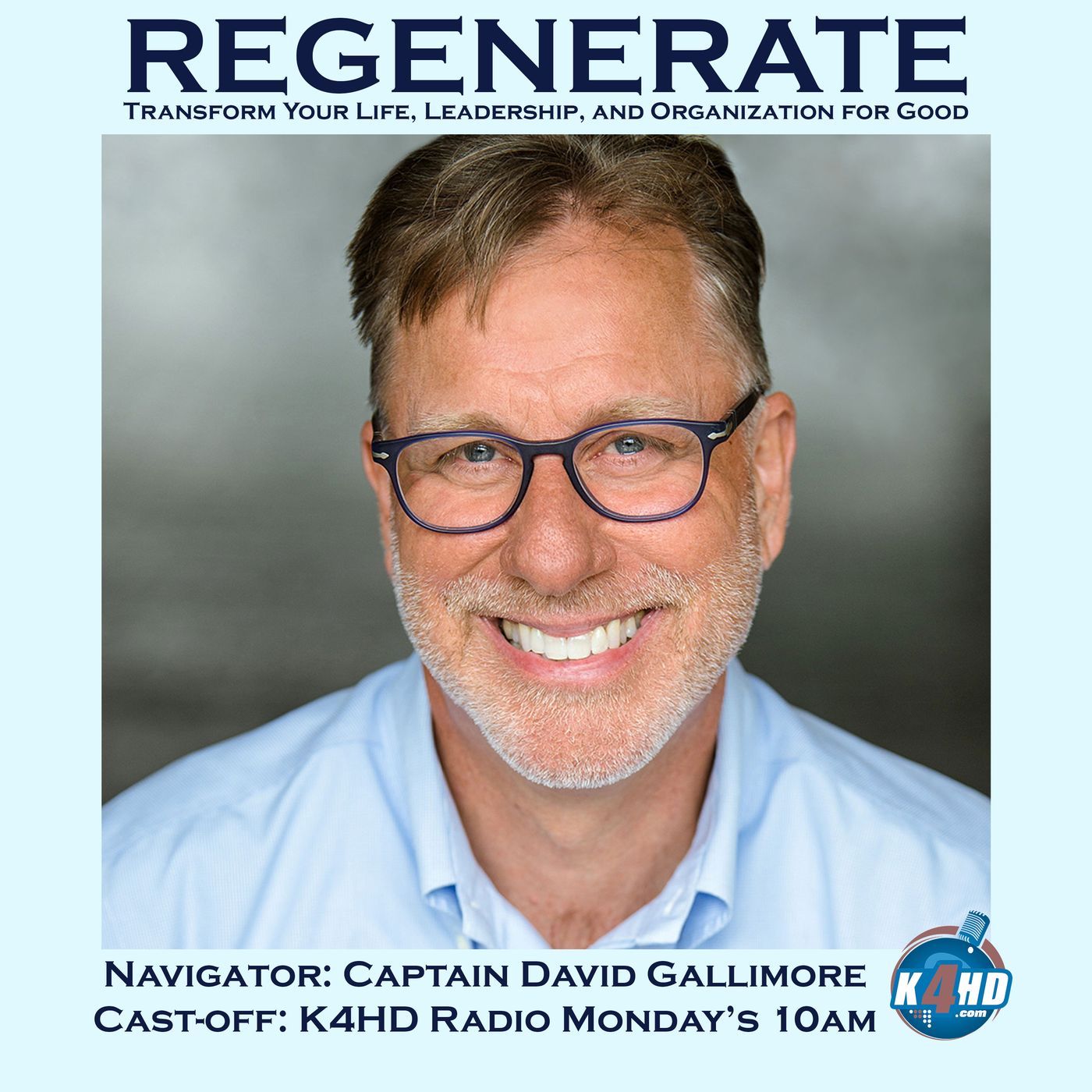
REGENERATE is broadcast live Mondays at 10AM PT on K4HD Radio - Hollywood Talk Radio (www.k4hd.com) part of Talk 4 Radio (www.talk4radio.com) on the Talk 4 Media Network (www.talk4media.com). REGENERATE TV Show is viewed on Talk 4 TV (www.talk4tv.com).
REGENERATE Podcast is also available on Talk 4 Media (www.talk4media.com), Talk 4 Podcasting (www.talk4podcasting.com), iHeartRadio, Amazon Music, Pandora, Spotify, Audible, and over 100 other podcast outlets.
Become a supporter of this podcast: https://www.spreaker.com/podcast/regenerate--6862974/support.
0:01 This program is designed to provide general information with regards to the subject matters covered. This information is given with the understanding that neither the host, guests, sponsors, or station are engaged in rendering any specific and personal, medical, financial, legal, counseling, professional service, or any advice. You should seek the services of competent professionals before applying or trying any suggested ideas. Ahoy! Captain David Gallimore welcomes you aboard the Regenerate Show, live Mondays, 10 a.m. Pacific on K4HD Radio at K4HD. com. We dive into the real messy work of transforming our lives, leadership, and organizations. Bring your hot mess and confusion. Believe with clarity, courage, and confidence. Together, let's strengthen our resilience, accelerating the health of ourselves, people, planet, and profits. Now, here's your host, Captain Dave, your personal regenerator. All aboard!
1:15 Ahoy, friends. Welcome to Regenerate. I'm Captain Dave, your personal regenerator. During the show, I strive to create a safe space for my guests to share authentic and vulnerable true stories about the messy middle of their personal, professional, and organizational transformation. These stories are so needed right now, given the challenging times, global political and climate uncertainty, the disruptions from generative AI. We're all navigating a lot of change. I want to point to hope. Regenerate. is about how you can become somebody who brings more resilience, purpose, and authentic energy to the people that you love and to our planet, our only ship that desperately needs our support. So what's the definition of regeneration? Well, my definition continues to evolve as I learn and live. I learned from Laura Storm, who leads a annual regenerative leadership journey. that regeneration draws on 3.8 billion years of life's own logic, restoring vitality across every living system as we inhabit ourselves, our families, our teams, our organizations, our communities. So, but together, we transform beyond merely doing no harm and become like a healthy forest, endlessly regenerating resilient, abundant life in all its forms. So
2:46 I created this show because I'm dedicated to lifting purpose-driven leaders up and connecting them in bonds of love, adventure, building, leadership, and impact. And as a transformational guide, maritime captain, and a lifelong learner, I'm living my Ikigai, which is the theme for this show. It's my reason for being. So I'd love to support you in your own regenerative journey. I invite you to check out this swiftly growing movement. And thank you so much for being here. I'm so grateful. If you're a longtime crew on this regenerative voyage, I appreciate you deeply. And if you're joining us for the first time, welcome aboard. I hope you discover something today that changes how you see yourself, how you might see others that you care about, and what's possible as a change agent, as someone who's able to really lean in on some of the juiciest challenges of our time. Please share these conversations with someone who needs them. Consider being their teacher and consider inviting more people into the regenerative movement.
3:51 As always, if you have ideas for future guests or topics, corrections, or feed forward, how can I improve? We want to hear from you. Please reach out to info at regenerativeworldgroup.com and I'll post that email in our show notes. And finally, please subscribe and leave us a review or a comment on whatever platform You're listening right now. Your support invites more purpose-driven leaders to find their way to this community, to navigate to a bold, regenerative today and future for all generations. Listeners of the show frequently say their time was well invested. So here's our promise. First, to have fun today when we're laughing, we're learning. Second, to leave you inspired. And third, to leave you with just one thing that you can apply before you go to sleep tonight.
4:38 So please grab a pen. Transformations happen here. So our theme today is Ikigai from Sunday dread to Monday purpose. So you've built real success, yet some Sundays, they still carry a quiet dread. But what if Monday became the day you couldn't wait for? So drawing from my Regenerate You playbooks, I'm going to walk you through the Ikigai playbook, the four circles of your reason for being. What do you love? what you're great at, what the world needs, and what you can be well-paid for. And then finally, the daily practice that turns dread into direction. So purpose, in my experience, isn't a destination you arrive at. It's a journey that you live into one morning or one week or one month at a time, depending on how you want to reflect and perhaps do some journaling and continuously improve. Your next epic chapter starts with a simple but not easy question. Why are you here? So our show is in three parts. Part one, why your reason for being matters. Part two, how can you draft your first ikigai, your first reason for being. And finally, part three, how to live and refine it daily, weekly, monthly, whatever cadence works for you. And through this show today, I'll be sharing personal as well as anonymized client stories to put a face on this, again, simple but not easy question.
6:13 Why are you here? So let's jump in. Part one, why your reason for being matters. So I want to tell a personal story, excuse me, about this, because I think it'll put a face on what I was experiencing. So I, back in 2021, was leading a business and technology team of about 35 people. And I was doing program management for a very innovative company, trying to figure out how to apply generative AI agentics to selling home insurance. Not exactly the most thrilling topic of a business, but hey, sole provider needed to earn the money. The gig paid very, very well. But as the year was wearing on, it was very clear to me that I wasn't really excited about this. I was starting to feel Sunday night dread.
7:13 And so that was further catalyzed during the November 2021 COP26 in Glasgow, Scotland. And I recognized that what I was doing to put food on the table, though it mattered to my family and I, it wasn't necessarily moving the needle on now what I believe is an existential challenge for our globe. which is how do we live differently and more aligned with nature. So I was very, very lucky. I got to understand my core values a few years earlier, which are love, adventure, creating and building, leadership, and impact. And I'm going to do a show on core values, which are slightly different than our shared human values of world peace family health so we'll do that next next week and this hopefully will be a nice dovetail between today's show and next week's show so that feeling of just not wanting to jump out of bed and get working was starting to grow and if you've experienced that you know how challenging and frustrating that can be and and it kind of bleeds into other parts of your life. At least it did for me. So I was more irritable. I know my wife, Margaret, married for 35 years now, back then, 35 years ago. So
8:48 married for 30 years. She really had to put up with a lot. I wasn't the easiest person to live with. And I also, and maybe this is just my brain wiring, but I didn't really have the courage at the time, like earlier in the year, 20, sorry, 2011, didn't have the courage to quit and go do something else. So I kind of just gave a little bit less week after week and a little bit less, and it was not very good, self-sabotaging, plus probably didn't give quite 110% that I'm known for giving to the client. They didn't see any challenges, but I know that I was not quite as committed and I didn't worry about emptying my inbox each day, which was a thing for me back then.
9:42 So I saw a different behavior showing up. And I just learned an interesting statistic that we are working roughly about 35% of our 24-hour day. So that's 92,100 working hours. And that just changes. me over the course of a lifetime career. And so doesn't that amount of working hours deserve a clear why? And so I discovered this idea of a reason for being based on Japanese philosophy. And I'm here to tell you that it was transformational. It gave me the kind of clarity that I was really lacking.
10:29 And so what I'd like to do now is talk a little bit about how you could draft your first Ikigai. Actually, you know what? I'm going to back up. I want to spend just a little bit more time talking about a couple of my clients. Again, names have been changed. to respect their confidentiality. And after the break, we'll come back and talk about part two, which is the, how do you start to draft your Ikigai? So I have a client, Jennifer, who just a lovely person, super smart, and was just not really connected to her Monday mornings either.
11:13 She was feeling the Sunday night dread. And she was referred to me by Sam, our Edward Jones financial advisor. And I was just really grateful for that referral. And I remember having our first Zoom conversation and she was just really, really challenged, really frustrated with her day-to-day work life. And she really wanted help to leave the organization that she was working with. And so I always start all of my career coaching work, client work, with the core values and the ikigai and sent out those two playbooks.
11:56 And she did some really, really thoughtful, reflective work. And as a result of what she came up with, and we kind of brainstormed different forms that her core values and ikigai could take. Think of core values, by the way, as your definition of success. What's that criteria? that you can then apply in making decisions about where you spend your time and perhaps even more importantly, your attention, your money, and then just resources. And so for those of us that are neurodiverse ADHD, having clarity about our core values, reach some of those guardrails and helps us say, no, thank you to things that are not really aligned with ideally three to, four of your five or six core values.
12:51 So again, a little movie trailer we'll be talking about core values next week. She also did some really great work on her Ikigai and soon realized that what she was doing across what was important to her was actually quite aligned. And that was a bit of an aha moment. And so Long story short, or as Margaret would remind me, too late, I discovered with her that she just needed to do her current role differently. What she was doing in her career really fed her. It was her purpose.
13:33 It was her reason for being. We just needed to come up with different strategies on managing up her boss and also helping her think a little bit more strategically about her day-to-day, because that was one element of her ideal day that was not being met, one of her core values of kind of freedom and strategy. So the second story I want to tell quickly is Mike, who came to me through startup.com and another really smart, very capable entrepreneur He was a non-profit founder, helping youth understand how they can leverage business and entrepreneurship to create a better future for themselves. And sadly, because of all the government funding changes, how we call it that, funding cuts, and just his own pivot, wanting to pivot his own career, he came to me and we discussed again, his core values and his Ikigai. And it was very clear that what he was doing, though it fed him, it was missing a big part of the Ikigai, which is being well-paid for what you do. And he was kind of growing a little bit tired of all the fundraising that he had to do as a non-profit executive founder. And
15:03 he pivoted with me to come up with a travel-related kind of a sales and marketing role at a very established entrepreneurial company, Global, that helps youth, specifically in high school and college, enjoy international experiences, learning experiences. And boy, when he got clear about his ikigai, he had been struggling to attract new opportunities. And I just think it was because he wasn't really clear about what he was wanting to attract. And if we're fuzzy about what we're wanting to attract, we rarely attract it. Kind of a law of attraction thing. Sorry, too many attractions, but I couldn't resist. So when he was really crystal clear about a Ziki guy and how much money he needed to make on a consistent basis, he attracted the job of his dreams. And I touched base with him periodically. He's been very, very willing to share his story. And so He was one of my early guests on the Regenerate show.
16:12 And so I invite you to check out Mike Shadroff and what he did. And we'll put that link to his show in the show notes. So those two examples. A woman who wanted to leave, but realized her current environment and the current work she was doing really fed her ikigai. And she earned an $ 85, 000 bonus and really had quite a quick turn as a result of our coaching collaboration. And then Mike, who was really looking to change as well. And it was the right thing for him to change. So two different stories, two different outcomes.
16:57 And for me, just to put a final exclamation point on my story, as a result of getting clear about both core values and Ikigai and having a bit more courage to say, you know, I can't keep doing what I'm doing. I need to change. I want to be a part of the solution to our rising global temperatures. I think business can be a force for good. And so I went all in with Margaret's support to be a regenerative life leadership and business coach. So I'm going to invite Rebel to start our commercial just a little bit early. This is a valuable offer from yours truly.
17:43 Would love to listen deeply to something that really matters to you, something that is keeping you awake at night. or something that is an opportunity that you would just love, love, love a sounding board. It's a free offer. Typically, these conversations last about 20 to 30 minutes. So Rebel, please roll that commercial. And when we're back, we're going to talk about how to draft your first geeky guy. You're listening to Regenerate with Captain Dave, your personal regenerator on K4HD Radio. We'll be right back. are you feeling overwhelmed are you ready to regenerate and live the life of your dreams Start the transformation now. Call Captain Dave at 253-237-2558. Stop overthinking. Again, call 253-237-2558 or go to regenerativeworldgroup.com to book a free, no obligation clarity call. Let's get back to regenerate right here on K4HD Radio for more life-changing transformations. Here's your host, Captain Dave, your personal regenerator.
19:07 Welcome back. If you're just now joining us, I'm my own guest again this week. I know so many great guests have said yes, so I'm excited about what's going to be happening in August, September, and beyond. But for right now, it's just little old me. I've been speaking about this concept of ikigai, your reason for being. Over the next 15 minutes, I'm going to teach you about how you can draft your first ikigai. I'm going to invite Rebel to please show the ikigai drawing. I'll briefly walk you through what that looks like. So what I love about this model is its simplicity. So on the very top of the model is a question about what you love to do. What really lights you up? What would you do if you were not getting paid? What would you do if you had six months to live?
20:07 So these are different questions that you will discover in the playbook. And it'll be my gift to you. I want to put in the show notes, we'll put a link on how you can download my Ikigai playbook, which over 105 clients since January of 2022 have successfully worked through this playbook. And like me, like Jennifer, like Mike, have become much clearer and therefore more manifesting their best lives. It's really quite remarkable. So as I go around clockwise, the next question is, what does the world need? So you may love, love, love something, and you would do it if you weren't getting paid for it. But the practicality is most of us need to earn a living.
21:01 And so part of that question then is, well, what does the world really need? And that's tricky sometimes to answer. But with generative AI, I have kind of co-developed with some of my more innovative and open and curious clients. We've developed some prompts that have really been helping do some research about, given what you love to do and the left circle, what you're really, really good at, not what you wish you were good at, but no, really no shit what you're really good at. When you look at the world through that lens of what you love to do and what you're really good at, it's way easier to find out what does the world truly need to satisfy your needs and theirs. And then the final circle is what can you be paid well to do? Now, I'm broadening the paid circle, the bottom circle, with what would give you not only monetary value, but also freedom, inner peace. So getting paid well, I've been thinking about it in terms of wealth. What does a wealthy life mean to you? Both financial, but also freedom and peace, inner peace and other non-financial definitions. of a life well lived.
22:35 So then you take these four circles and the intersection of them are your ikigai, your reason for being. Now, I'm not going to go into the detail of the intersection of some of these other circles, but they're very, very helpful, kind of give you a sense of, okay, where might I be relative to these four circles? And then the questions that are in the text that are outside the four circles, really, really thought-provoking. So this model I discovered, and it is based on the blue zones.
23:20 The Okinawa is one of those, and that's where this came from in Japan. And in the show notes and in the playbook, you will see go into quite a bit of detail about this. So Rebel, if you want to just take that down, it'll just be me again. Thank you so much. So how do you put this together? Well, the first thing is to get into a quiet place. I love going into nature when I do this kind of reflective work, but it really doesn't matter where you are. It just needs to matter that you're able to kind of simplify and and reduce the distractions and noise that might happen over the next 30 minutes or so. So turning off notifications. By the way, if you haven't turned off notifications just for all the apps that we have, I'll tell you that's been transformational for me because my neurodiversity, ooh, shiny object, ooh, notification, ooh. And we all know that human brains are not very good at multitasking. We're good at time slicing. But if you're doing deep work and you get a notification that pops up, that's going to interrupt that deep work. You might get sucked into some social media link. You might get sucked into some drama that somebody else needs you to deal with. It's not supportive of the deep work that you were doing at
24:52 that moment. So that's been a game changer for me to turn off all of my notifications, except for key messaging from my wife and my son and daughter and other people that I need to be more available for. So whatever that space is for you, try to get quiet. I find that it's helpful to have some water or your favorite adult beverage can be helpful too, can be relaxing. Have some favorites. Food could be healthy food like fruit and vegetables, hummus. Those are some of my favorites. Or it could be your favorite chips and dip, chips and salsa.
25:36 I find that having something to munch on, keep my need for crunch going, and then just keeping your blood sugar up. Because this is challenging work. I'm here to tell you it's simple. And it's not easy. So give yourself every opportunity by create that environment that will best support you. So the process that you will find in the playbook, and I want to make sure I put his name properly. So I read an article and I'm just scanning my playbook almost there. So Hamza Khan, he's a writer. And he wrote a really interesting article that I'll also put in the show notes. And then he had in his article, the Ikigai diagram that comes from the Toronto Star. And he asks a series of questions.
26:34 And I thought these questions were so helpful. The first question has to do with, is what you're doing today something you're truly passionate about? So this is in the what you love circle. could you enthusiastically talk about your work, your industry, your profession for hours on end? And when I answered that question, honestly, mine was kind of a medium. I gave it a yellow yes and a yellow no. So I was kind of right in that middle. Another question that you'll find in the playbook, are you emotionally connected to the results of your work? Do you think that you could out-care other people in your field? And I definitely said no on that. And then another question that Hamza asks is how, let me go to the question specifically here. If you weren't concerned about money, would you still do what you're doing? And I gave an emphatic no, thank you to that. In terms of what the world needs, are you helping to solve an actual problem?
27:45 Another question is, is the marketplace demanding what you have to offer? Are people willing to part with their resources, time, money, attention to buy what you're selling, or in this case, exchanging your time as an employee? And then finally, will this work still be needed 10 years from now? Here's a big question. How about 100 years from now? And if not, will the value of your work today increase? over time. So those were pretty thought-provoking questions, I thought, that Hamza had come up with. In terms of the what are you good at circle, are you useful? Is what you do something that your friends or family or community have sought your advice or opinion on before? And I gave a pretty emphatic yes to that. Are you among the best in your workplace community at this? How about in your city, in your country, in the world?
28:37 And I said yes, because I've been doing it for almost 35 years. So each of these categories, each of the four circles has about three questions and you just answer yes or no. And then the process I thought was really, really valuable in that you would take those questions and create a table. And in that table, you start to put your answers about what do you love? What are you good at? What you can be well paid for? And what does the world need? And when I did that, I started to see connections in what I loved, what I was really gifted at, what the world needed, and what I could be well-paid for. And I saw the gaps in that as well. So you see the connections, the overlaps, and then you see the gaps. Now, this is where it gets a little bit challenging for an individual. I had to do this with my friend and colleague, eric eckert in belgium who i invite you to go to the second show of the regenerate show where he talks about emotional mastery among other subjects so he was very very gifted as was michio graham who was my first guest where we were talking about identity so those first two shows of the regenerate show i i I strongly invite you to listen and you may glean some insights about how did I approach this pivot that I wanted to make from the corporate crazy to
30:10 being a solopreneur and helping leverage business for good, for people, planet, profit, and purpose. So that table was very helpful, but it was really valuable to really talk through it with somebody else. So if you have a significant other or a best friend, somebody that you know will tell you the truth so that you keep it honest. Otherwise, you can do what I call fiction writing, and that's not going to serve you. Let me go back to our outline here. So the ideal is to brainstorm freely. You don't have to do it in one 30-minute session. It could be spread out over a series of of days even even weeks the main thing is when you come back to this key guy questioning yourself it's it's important that you are able to get to that quiet place and and really start to listen to the inner heart and head when those two are speaking and i know that seems a little bit uh funny the way that I say that or kind of fuzzy. But what I mean by that is if you can get into a, a quiet environment and be in a reflective state of mind, and you listen to and, and think about moments in your life that really were emotionally uplifting, emotionally satisfying, that's, that's the heart
31:44 part of it. And then the head part is, you know, what was really challenging because I think human beings, generally speaking, we, find greater purpose when we're facing challenges. Not that we want to have problems. Problems are very, very exhausting. But yeah, challenges that will help give your life, give your day more meaning because you're a problem solver. Human beings typically are problem solvers. And if you don't have appropriate problems to solve, that's when you can self-sabotage by creating your own problems, and then solving those, or what I like to call the arsonist firefighter. An arsonist firefighter is the person who sets their own fire, creates their own problems, so that they can then put out the fire or solve their own problem. Don't be that person. I've been that person sometimes.
32:40 Not literally. I've never been an arsonist. I just want to clarify. But that whole idea of if you don't have juicy problems to solve or juicy challenges to overcome, there's a tendency for us human beings to sabotage and make those problems up. That's where Nikigai can help you get a bit clearer about, well, what problems, what challenges do I really love to solve? What value do I really want to bring to the world? And so that head and the heart, being able to combine those two voices, it's really magical. Rebel, I'm right on time with my Part three. So here we go. So part three is live and refine this first draft. Now, when I was doing this work with Barrett and Mathieu, I found that a weekly cadence was very good. Recently, I've been doing a bit more of a daily cadence because I'm now refining my Ikigai again based on the four and a half years of doing this work. So what's the process for refining it? Well, there's kind of four ways to do this. One is to, if you have a journaling practice where you're reflecting on, Hey, I had an intention yesterday to do maybe three really important things. Maybe one that was really hard, a challenge that I wanted to overcome to, you know, something that was important to somebody else. Um, and then, you know,
34:12 a third one that, um, was just going to light me up, you know, really fun. So I always try to think in threes. I'm a musician, and so the triad, it's a lovely sonora sound. It's got structure, but it's got beauty. A three-legged stool, you know, that's a very stable structure as opposed to a four-legged stool or a four-legged table that can have one leg shorter or longer. And both the stool and the table can wobble. So having three things that you intend to get done in the day has been a game changer for me. And if you get those three done, then you add the next one or the next one. But reflecting on those three things, if you have that practice the next morning, then how did it go? What did you do well?
35:05 Celebrate those wins? What was one thing that maybe got in the way? kept you blocked. That kind of reflection on the day doesn't take very long, five minutes, maybe 10, if you have more to say. But include now the ikigai in that reflection. Like, well, how much did I get to express what I love to do? Did I get to make a difference in the world in a way that lit me up, gave me joy, was not too challenging? you know, like it's in the problem category, but not so easy that you kind of felt bored maybe and you lit your own fire. Please don't do that.
35:50 It's not fun. And so in that reflection time where you're kind of layering in the Ikigai questions, you can really iterate your Ikigai quickly. I'm finding that again. It's been really, really valuable, really helpful. And Part of the reason for refining your Ikigai periodically, I think I waited too long. I would say it's probably a good thing to do annually because we're constantly changing, aren't we? We're evolving. And this idea of being able to have incremental change. So you may have heard me talk in prior shows, and I'll have to think about which shows I did talk about that, and I'll put them in the show notes.
36:38 But this idea of 1% improvement daily, just 1%. Now, is that something you can measure? No, it's more of a hopeful frame, a reframing. You have a growth mindset, growth mindset being, I'm not there, dot, dot, yet, but I'm in process of getting there. So how can you break change that you would like to see in your life, be it better habits, could be walking more, eating less sugar, sleeping a little bit more, which are three of my health challenges right now that I'm working on. I probably will be for the rest of my life. But every morning I'm reflecting on how am I doing that just get a little bit better, 1% daily. And with the power of compounding, this is really where I think the 1% idea starts to really soar, take off. With compounding, like each 1% improvement each day builds on the previous 1% improvement. And just like compounding with an investment portfolio or your checking or savings account, wherever you are getting interest, compounding interest, guess what that compound effect is at the end of 365 1% incremental improvements? It's 3,700% improvement or
38:08 37 times improvement so is that a formula that uh you know you can measure that no but it's a mindset that if you can break big goals big challenges big opportunities into small bite-sized chunks which i talked about last week how do you eat an elephant one bite at a time This idea of 1% daily toward your ideal ikigai, you will accelerate what your life looks like. We did that with Jennifer. I did that with Mike. I did that with many, many other clients. And that sense of momentum, that sense of movement towards something that really truly matters to you, oh my gosh. I mean, it is the difference between Sunday dread and Monday purpose.
38:57 So I really invite you to consider adding this idea of an ikigai process, reflecting to the extent that you would like on one or more of those circles. So what do you love? What are you good at? What does the world need? And what can you be well paid for? Or if you're not currently working and don't need to work, you could be retired or you could be a homemaker and you're not needing to make money. How can you be well compensated could be in terms of freedom or inner peace or something that's not monetary for you because that's not important to you at this time of your life. So you're reflecting, you're drafting some ideas that resonate with both your head and your heart You get to refine those over the course of days or weeks. And at some point you may say, you know, I'm good. I don't need to do this on a daily or weekly or monthly or annual basis.
40:03 Right. Some people are totally fine with once they get really, really clear, they don't need to change. And there are many of us, I include myself in this, where we are more interested in the challenge of changing and growing more on a continuous basis, to leave ourselves a little bit better for the world, to be a little bit more inner peace, a little bit more freedom, a little bit more wealthy. And so whatever that cadence is for you, I invite you to put on your calendar, hey, I'm going to reflect on my ikigai, and I'm going to repeat that daily, weekly, monthly, quarterly, annually, whatever that is, and be absolutely happy. amazed at how your world can attract or how you can attract a world that really is your reason for being so um our next port of call next week our theme is going to be core values and once again i'll be my own guest hopefully you're not getting as sick of me as i am of me so we're going to be discussing how discovering and refining what matters most to you can be another tool of transformation in my experience, by getting crystal clear about my core values. And that does include universal human values shared across the globe of peace, health, family.
41:29 Those are shared regardless of culture, men, women, any other identities, gender identities, ages. Those are the universal human values that we all share. This is that next level of depth and kind of personalized for who you are. So please join us for episode 26, Core Values, Your Definition of Success, next Monday at 10 a.m. Pacific, 1 p.m. Eastern, and 6 p.m. CET on k4hd. com. And then the following days, your favorite podcast platforms. So check out our website at www.theregeneratepodcast.com.
42:12 Thank you so, so much for investing your valuable time with us. On behalf of Rebel Meddler, our producer, our entire Talk4Media team, please stay healthy. Stay safe. We need you. We're better together. Now let's go regenerate. Thank you for listening to Regenerate with Captain Dave on K4HD Radio. We invite you to give yourself grace and grace the messy middle. See you every Monday at 10 a.m. Pacific time. Until then, you got this.


